
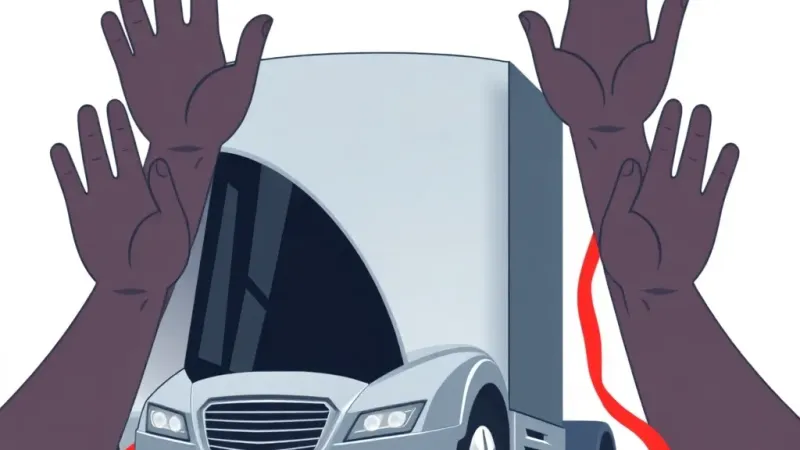
Legislative bodies across several key states are actively moving to impose significant restrictions on the burgeoning autonomous trucking industry, signaling a decisive shift from unbridled innovation to cautious regulation. This wave of state-level action, characterized by proposed bills and mandates, aims to temper the rapid expansion of self-driving big rigs, primarily driven by escalating safety anxieties and profound concerns over job displacement within the commercial driving sector. The emerging patchwork of state regulations threatens to complicate national deployment strategies for technology developers, who have largely operated under a less stringent federal oversight framework until now.
Lawmakers in states like Pennsylvania, Ohio, and California are reportedly contemplating legislation that would either require a human safety operator to remain onboard all autonomous trucks, even during fully driverless operations, or impose rigorous new certification processes far exceeding current federal guidelines. "The promise of autonomous technology is compelling, but public safety cannot be sacrificed on the altar of progress," stated Representative Eleanor Vance of the Pennsylvania State Assembly, a key proponent of new safety mandates. "We need to ensure these machines are truly ready for our highways before we unleash them without adequate human oversight." Another proposed bill in Ohio seeks a five-year moratorium on fully driverless trucking, allowing for comprehensive impact studies on employment and infrastructure.
The industry, while acknowledging the need for public trust, argues that state-level intervention could stifle innovation and impede the efficiency gains promised by autonomous logistics. "Our technology is designed to enhance safety, not diminish it," commented Dr. Julian Hayes, Head of Policy for 'RoadRanger Robotics,' a leading autonomous trucking firm. "Autonomous systems eliminate human error, which accounts for over 90% of truck-related accidents. A fragmented regulatory landscape only creates unnecessary hurdles, delaying the very safety benefits these systems offer and hindering our ability to address the nationwide driver shortage." Proponents also highlight the potential for reduced fuel consumption and optimized supply chains.
However, critics remain unconvinced by industry assurances, pointing to the complexity of real-world driving conditions and the unpredictable nature of sensor failures or software glitches. Unions representing truck drivers have vociferously lobbied against unchecked deployment, emphasizing the existential threat to millions of livelihoods. "These trucks aren't just a technological marvel; they represent a potential economic tidal wave that could devastate communities built around the trucking industry," asserted Marcus "Mac" O'Malley, President of the fictional 'United Freight Haulers Alliance.' "We're asking for a pause, a moment for society to truly grapple with the full implications, not just the technological advancements."
As legislative sessions progress, the outcome of these state-level debates will significantly shape the operational future of autonomous freight. The emerging state-by-state scrutiny marks a critical juncture for the industry, compelling developers to not only prove the efficacy and safety of their technology but also to engage more robustly with public concerns. The path to fully autonomous trucking, once envisioned as a clear highway, now appears dotted with an increasing number of regulatory checkpoints and a growing demand for transparency and accountability from legislative bodies determined to prioritize local interests.


