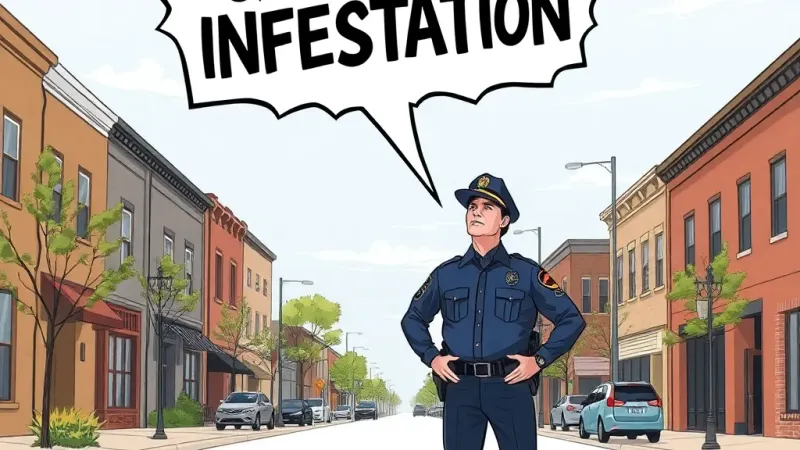
Colorado State Representative Scott Bottoms, a self-identified "far-right" Republican eyeing the governor's mansion, has recently promulgated assertions regarding a pervasive "gang infestation" within the state. These emphatic claims, intended to underscore a perceived crisis in public safety, have notably failed to garner support or corroboration from local law enforcement agencies, presenting an unusual divergence from typical political-police alignments on crime narratives.
Bottoms, known for his outspoken conservative views, has seemingly sought to elevate his profile among a particular segment of the electorate by portraying Colorado as under siege from organized criminal elements. His rhetoric suggests a dire situation demanding immediate, robust intervention, painting a picture of rampant gang activity threatening the very fabric of communities across the Front Range and beyond. Such pronouncements often aim to resonate with voters concerned about crime rates, framing the issue in stark, unambiguous terms.
However, police departments, which typically might find common ground with politicians advocating for increased law enforcement resources or a tougher stance on crime, have maintained a noticeable distance from Bottoms’ specific allegations. Officers and spokespersons, when pressed, have either declined to comment directly on the representative's statements or have emphasized data-driven assessments that do not align with the narrative of an overwhelming, widespread "gang infestation" of the magnitude Bottoms describes.
"Our department prioritizes public safety through intelligence-led policing and relies on concrete evidence to define threats," stated Sergeant Elaine Ramirez, a spokesperson for the Front Range Law Enforcement Council, in a recent interview. "While we continuously combat gang activity, which remains a persistent challenge in specific areas, the characterization of a statewide 'infestation' lacks the granular detail and comprehensive data that informs our operational strategies. It's crucial that public discourse on crime is grounded in verified facts."
This cautious posture from law enforcement suggests a calculated decision to avoid endorsing rhetoric they perceive as hyperbolic or not fully supported by their own intelligence. The reluctance to echo Bottoms' claims could stem from a desire to maintain credibility with the public, prevent undue panic, or simply a professional commitment to presenting an accurate, rather than politically charged, assessment of the state's criminal landscape.
The disconnect between Bottoms’ assertions and the measured responses from police officials poses a potential challenge to his gubernatorial ambitions. Voters often expect consistency and corroboration when politicians make sweeping claims about public safety. As the election cycle progresses, the ongoing scrutiny of his unsubstantiated gang claims may force Representative Bottoms to either provide more specific evidence or temper his rhetoric to align more closely with the operational realities reported by those on the front lines of law enforcement. The debate underscores the delicate balance between political messaging and factual representation in public discourse.