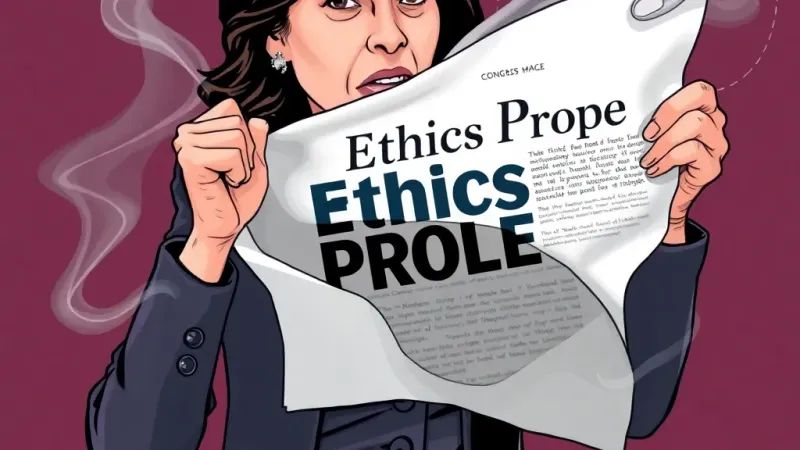
Congresswoman Nancy Mace (R-S.C.) issued a forceful condemnation on Tuesday, excoriating political operative Patrick Bryant for what she vehemently described as a "fictitious ethics investigation" aimed at undermining her legislative agenda and public standing. Speaking from her Washington D.C. office, Mace characterized Bryant’s alleged actions as a blatant attempt to mislead the public and obstruct critical work within the House.
The contentious dispute centers on claims by Bryant, widely disseminated in local political circles and online, regarding an unspecified ethics probe into Mace’s campaign finances and staff conduct. However, Mace’s office asserts that no such investigation has been formally initiated by any legitimate congressional ethics committee or independent oversight body. "This isn't just misinformation; it's a deliberate fabrication designed to sow doubt and distract from the tangible issues affecting our constituents," stated Eleanor Vance, a senior legislative aide to Congresswoman Mace, in an official communication to reporters. Vance emphasized that the Congresswoman’s office has thoroughly reviewed all pertinent channels and found zero evidence supporting Bryant’s assertions.
Congresswoman Mace did not mince words, directly accusing Bryant of engaging in political theater devoid of any factual basis. "Mr. Bryant’s desperate tactics are a disservice to the integrity of public service and a transparent attempt to weaponize baseless accusations for personal or political gain," Mace stated in a press release. She further elaborated that such maneuvers waste valuable time and resources that could otherwise be dedicated to legislative priorities, including economic development and healthcare reform. Mace’s office has called upon Bryant to retract his statements and provide verifiable proof of any such investigation, a request that has reportedly gone unanswered.
Patrick Bryant, a known figure in regional political strategy, has yet to issue a public response to Congresswoman Mace's pointed accusations. Efforts to reach Bryant for comment by several news outlets, including this publication, have been unsuccessful. The absence of a rebuttal from Bryant has only intensified speculation regarding the veracity of his initial claims. Political analysts suggest that this escalating rhetorical battle underscores the increasingly fraught nature of intra-party and inter-party dynamics, where the line between legitimate scrutiny and politically motivated attacks often blurs. Dr. Marcus Thorne, a professor of political science at Georgetown University, commented, "When unsubstantiated claims are circulated, even without official backing, they can create significant reputational damage, irrespective of their truth. This incident highlights the challenges public figures face in countering narratives built on rumor rather than fact."
Mace’s office maintains that they will continue to focus on their legislative duties, refusing to be sidetracked by what they label as "political stunts." The Congresswoman has indicated she is exploring all available options to address the dissemination of what she deems to be false information, emphasizing the need for accountability in public discourse. The episode serves as a stark reminder of the rigorous scrutiny public officials endure and the constant battle to safeguard factual accuracy in the political arena.