
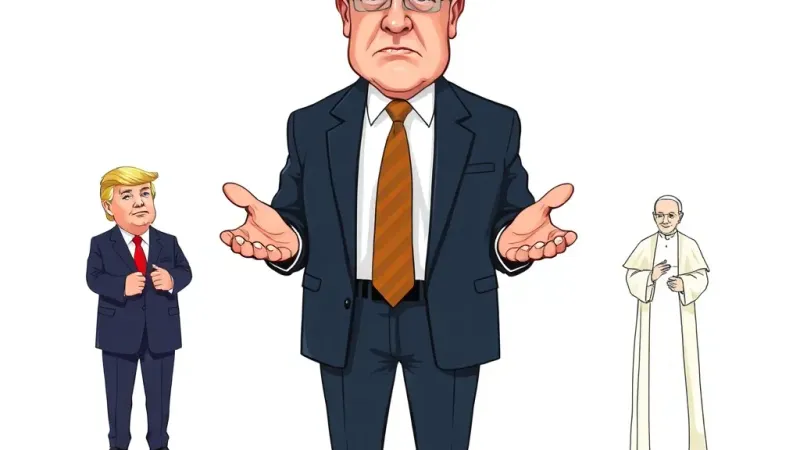
In an unexpected declaration, conservative media stalwart Bill O'Reilly has publicly offered his services to mediate the perceived diplomatic tension between the White House and the Holy See, stemming from recent interactions between President Donald Trump and Pope Francis. O'Reilly, a prominent voice in American political commentary for decades, posited that his unique understanding of both sides of the ideological spectrum would make him an ideal, albeit unconventional, arbiter.
"I can go to Rome and mediate the two sides, and the reason I can do it is I understand both sides," O'Reilly stated, outlining his confidence in his capacity to navigate the complex nuances separating the secular political sphere from the spiritual authority of the Vatican. This bold proposal arrives amid discussions surrounding the decorum and perceived disagreements that have characterized recent engagements between President Trump and Pope Francis, particularly concerning issues ranging from immigration policies to economic justice.
O'Reilly elaborated on his personal perspective as a practicing Catholic, noting that President Trump’s conduct, which has been subject to scrutiny by some, did not personally offend him. "President’s decorum wasn’t offensive to me and I’m a Catholic," he clarified, suggesting that his personal assessment could bridge potential misunderstandings or exaggerated perceptions of offense within the Catholic community or the Vatican. This stance is critical to his self-appointed role as a potential peacemaker, indicating a bridge-building philosophy that seeks common ground rather than exacerbating divides.
The notion of a seasoned media figure, known for his confrontational style, stepping into the delicate realm of international religious and political mediation is certainly novel. O'Reilly's long career at the helm of Fox News' "The O'Reilly Factor" cultivated a strong following among conservative audiences, granting him a direct line to a significant segment of President Trump’s base. Simultaneously, his Catholic upbringing and public discussions on faith could, he argues, lend him credibility within Catholic circles, offering a rare confluence of influences.
Observers suggest that while O'Reilly’s offer highlights the ongoing chatter around the relationship between the two global figures, the practicalities of such an intervention remain largely speculative. Official diplomatic channels typically handle such matters, yet O'Reilly’s willingness to personally intervene underscores the public's perception of a palpable disconnect requiring unconventional solutions. His proposition is not merely an opinion but a proactive offer to engage directly in a highly visible and significant international discourse, positioning himself as a unique, self-appointed diplomat in a charged global landscape. The former television host clearly believes his experience and dual understanding provide a distinct advantage in resolving what he perceives as a communication gap rather than an intractable ideological chasm.


