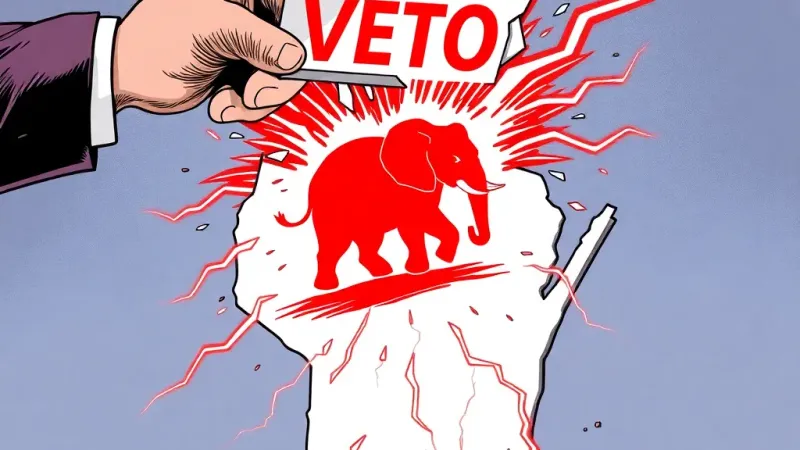
Madison, WI – Governor Tony Evers’ recent veto of Assembly Bill 317, a bipartisan legislative package aimed at providing significant tax relief to middle-class families and small businesses, has inadvertently handed the Republican-controlled legislature a formidable political advantage. Political analysts and strategists from both sides of the aisle are now assessing the unexpected fallout, which appears to have invigorated the opposition ahead of critical electoral contests.
The bill, which proposed an estimated $650 million in annual tax cuts, had garnered considerable support, passing both chambers with comfortable majorities that included several Democratic votes. Governor Evers, however, cited concerns that the package disproportionately benefited wealthier individuals and could jeopardize long-term state fiscal stability, arguing for more targeted relief in his veto message issued on Tuesday morning. This move, intended to champion fiscal prudence and equity, has instead created a rallying cry for Republicans.
State Senator Marcus Thorne (R-District 23), a vocal proponent of the tax relief, wasted no time in condemning the governor’s action. “This was a clear opportunity to put more money back into the pockets of hardworking Wisconsinites struggling with inflation,” Senator Thorne stated in a press conference held moments after the veto was announced. “The Governor has turned his back on the very people he claims to represent, proving once again that his priorities are misaligned with the economic realities faced by our citizens. This ‘gift’ from the Governor unifies our message and energizes our base like nothing else could have.”
Indeed, Republican strategists are already incorporating the veto into their campaign narratives, framing it as an obstructionist move against popular economic relief. Dr. Evelyn Reed, a political science professor at Capital University, observed, “While the Governor’s intentions might have been to hold the line on state spending and advocate for a more progressive tax structure, the immediate political optics are challenging. Republicans now have a concrete example to highlight perceived Democratic overreach and fiscal irresponsibility, appealing directly to a broad swath of voters concerned about their wallets.”
Democratic operatives, while acknowledging the immediate public relations challenge, maintain that the governor’s long-term vision is sound. “The Governor is committed to responsible governance, ensuring that any tax relief is sustainable and equitable across all income brackets,” commented Brenda Chen, a spokesperson for the Democratic Party of Wisconsin. “We believe voters will ultimately understand that thoughtful fiscal management, not reckless tax cuts, is what’s best for the state’s future.”
Despite this defense, the consensus among political observers is that the veto has injected a potent new dynamic into Wisconsin politics. With municipal elections approaching and the next gubernatorial race on the horizon, the veto of Assembly Bill 317 could serve as a foundational talking point, shaping debates around economic policy, governmental accountability, and the division of power for months to come. The unexpected political windfall for Republicans underscores the often-unpredictable consequences of high-stakes legislative decisions.