
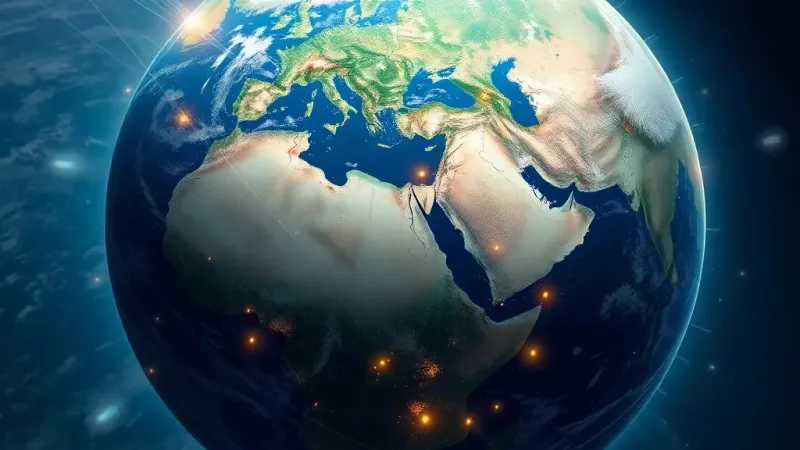
The Daily Gazette recently published a compelling commentary underscoring the indispensable role of space-based observation systems in deciphering the intricate tapestry of Earth's environmental changes. Authored by Dr. Aris Thorne, a theoretical astrophysicist and lead analyst at the Global Environmental Observatory Consortium (GEOC), the piece, titled "Our Blue Marble, From Afar: A Cosmic Mirror to Our Terrestrial Fate," posits that humanity's gaze upward has paradoxically provided the clearest view of its challenges below.
For decades, an ever-growing constellation of satellites has diligently monitored our planet, accumulating a trove of data that forms the bedrock of modern climate science. Dr. Thorne's commentary synthesizes findings from various international missions, painting a stark picture of accelerated global warming. Detailed measurements from instruments aboard NASA's ICESat-2 and ESA's Sentinel missions, for instance, have chronicled unprecedented rates of ice sheet melt in Greenland and Antarctica, contributing significantly to rising sea levels. Oceanographic satellites have mapped warming ocean currents, while atmospheric sensors track the increasing concentrations of greenhouse gases, offering incontrovertible evidence of anthropogenic impact.
"These orbital observatories are not just technological marvels; they are humanity's collective diagnostic tools," Dr. Thorne stated in the commentary. "From 400 kilometers above, the trends are undeniable: the Earth system is under profound stress. The data we collect is not merely scientific curiosity; it is an urgent dispatch from our planet, demanding an immediate, coordinated response." He emphasized that the sheer volume and precision of this data eliminate any ambiguity regarding the trajectory of our climate.
The commentary further explored the broader societal implications of these observations. It highlighted that precise satellite mapping of agricultural lands is crucial for food security planning, while weather prediction models, heavily reliant on space data, are essential for disaster preparedness in an era of escalating extreme weather events. The article suggested that nations, traditionally focused on terrestrial matters, must increasingly integrate space-derived environmental intelligence into their policy frameworks. This integration, according to Dr. Thorne, is not merely beneficial but a strategic imperative for long-term global stability.
The piece concludes with a powerful call for collective action, stressing that while satellites can reveal the symptoms, the cure lies firmly on Earth, in human innovation and political will. "The view from space offers both a warning and an opportunity," Dr. Thorne wrote. "An opportunity to understand, to unite, and to safeguard the unique blue sphere we call home. The data is clear; the choice is ours." The commentary serves as a potent reminder that the pursuit of knowledge beyond our atmosphere is inextricably linked to the preservation of life within it.


