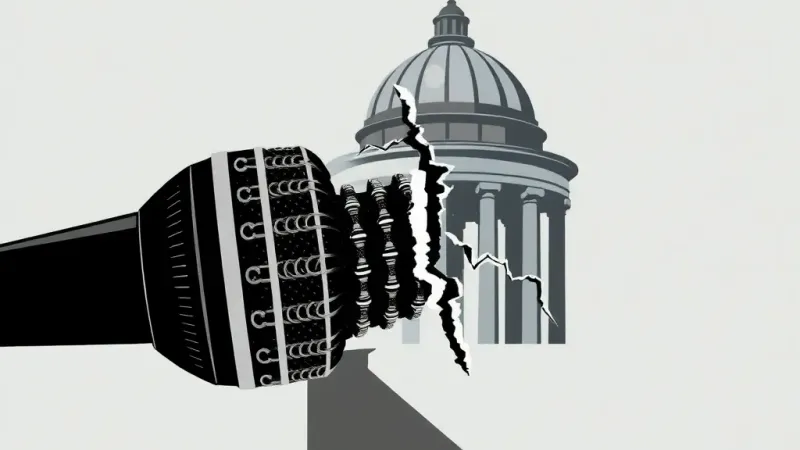
Reginald "Reg" Maxwell, a respected journalist who spent three decades at the Chicago Tribune, culminating in a significant tenure editing political coverage, has delivered a scathing indictment of the modern press, asserting that its current practices are actively failing democratic principles. In a recently published white paper titled "Echo Chambers and Empty Accountability," Maxwell contends that the industry's shift towards merely documenting official statements rather than rigorously challenging them has severe repercussions for an informed citizenry.
Maxwell, who retired from the Tribune in 2021, states that the pressures of the 24/7 news cycle and an increasingly polarized media landscape have pushed many newsrooms into a reactive, rather than investigative, stance. "We've become expert stenographers," Maxwell writes, "dutifully recording every pronouncement from politicians and institutions without the necessary contextualization, fact-checking, or critical analysis that true journalism demands. It's an easier path; you don’t get a lot of complaints if you just write down what everyone says and leave it at that." This "stenographic journalism," he argues, creates an illusion of balance while neglecting the fundamental journalistic duty to seek truth and hold power accountable.
The veteran editor points to several systemic issues contributing to this perceived decline, including diminishing resources for investigative reporting, the fragmentation of audience attention across myriad platforms, and an institutional aversion to being perceived as biased. He recalls a different era where political desks were heavily invested in digging beneath the surface of official narratives, rather than simply amplifying them. "Our mandate was to interrogate, not just transcribe," Maxwell stated in a recent interview following the paper's release. "When we abdicate that responsibility, we surrender the public's right to understand the full truth, not just the curated versions."
Dr. Eleanor Vance, a professor of media ethics at Northwestern University and a frequent commentator on journalistic practices, echoed some of Maxwell's concerns. "Reginald Maxwell highlights a critical vulnerability in our media ecosystem," Vance explained. "The temptation to prioritize speed over depth, and to avoid perceived controversy by presenting all sides without sufficient vetting, can inadvertently empower misinformation and deepen societal divides." Vance suggests that while the challenges are immense, news organizations must consciously recalibrate their missions towards a more active, analytical role.
Maxwell's critique extends beyond individual journalistic choices, implicating the broader media ecosystem in what he perceives as a profound democratic crisis. He implores news leaders to re-prioritize deep investigative work, revive the practice of challenging official narratives, and rebuild public trust through transparent, courageous reporting. The future of an informed electorate, he concludes, hinges on the press's willingness to reclaim its foundational role as an independent arbiter of truth, rather than a mere conduit for information.