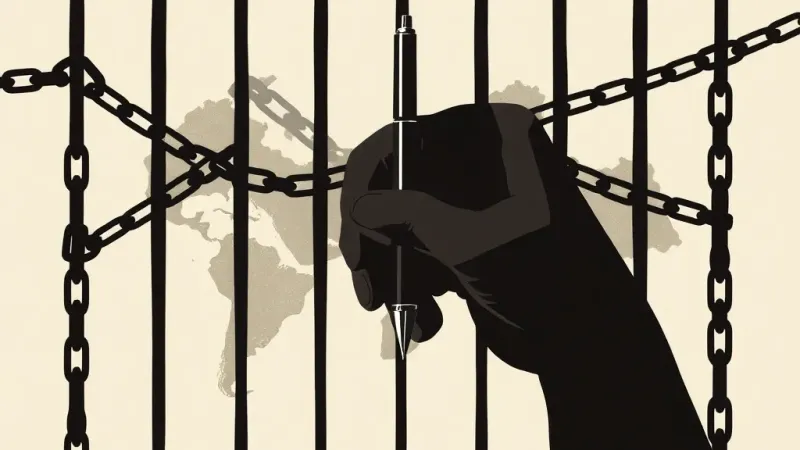
ISTANBUL, TURKEY — A Turkish court has sentenced prominent investigative journalist Caner Demir to two years and seven months in prison on charges of “insulting the president” and “spreading disinformation,” a verdict that has ignited a firestorm of condemnation from international rights and press groups. The ruling, handed down Tuesday, centers on Demir’s critical reporting regarding government economic policies and official responses to recent natural disasters.
Demir, known for his incisive analysis and often confrontational questioning of state narratives, was found guilty under Turkey’s controversial disinformation law, enacted in October 2022, alongside an existing statute on presidential insult. His legal team vehemently denies the allegations, asserting that the charges are politically motivated and constitute a direct attack on freedom of the press and expression in the country.
The Stockholm Center for Freedom, a prominent advocacy group, was among the first to issue a forceful statement, calling for Demir’s immediate and unconditional release. Numerous other international bodies, including the International Press Watch Alliance and Reporters Without Borders, have echoed this demand, highlighting what they describe as a systematic erosion of democratic freedoms under the current administration.
“This verdict is a chilling testament to the deteriorating state of press freedom and the judicial weaponization of laws against critical voices in Turkey,” stated Elara Vance, director of the International Press Watch Alliance, in a press conference following the ruling. “Journalists must be free to report on matters of public interest without fear of arbitrary detention or politically motivated prosecution. Demir’s imprisonment sends a deeply concerning message to the entire journalistic community.”
Critics argue that the disinformation law, officially aimed at combating fake news, is broadly worded and frequently misused to silence dissent and suppress inconvenient truths. Since its implementation, numerous journalists, activists, and ordinary citizens have faced investigation or prosecution, contributing to an atmosphere of self-censorship within the Turkish media landscape. The government maintains that these measures are essential for national security and to protect the public from malicious propaganda.
Demir’s case is now poised to become a focal point for international monitoring bodies, adding to the growing list of concerns regarding human rights and the rule of law in Turkey. Appeals are expected, but the immediate impact on press freedom advocates remains profound, underscoring the formidable challenges faced by independent journalism in a nation increasingly scrutinized for its democratic backsliding.