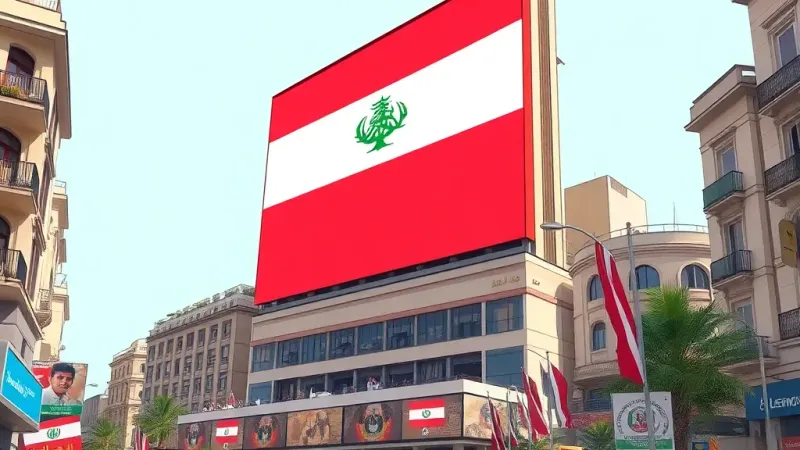
A striking visual monument, recently unveiled in a prominent district of Beirut, has rapidly transcended its physical form to become a visceral symbol of Lebanon’s precarious sovereignty and the deepening reach of Iranian influence. The towering installation, prominently featuring a stylized depiction of Qassem Soleimani, the late commander of Iran's Islamic Revolutionary Guard Corps' Quds Force, flanked by a map of the 'Axis of Resistance,' has ignited a fierce national debate, underscoring the complex geopolitical currents threatening the nation’s fragile independence.
Erected without apparent official impediment in the southern suburbs of Beirut—a known stronghold of Hezbollah, Iran’s powerful Lebanese proxy—the monument defies traditional state authority. It is not merely a memorial; it is a declaration. The inscription, boldly presented in both Arabic and Farsi, proclaims, 'The Path of Martyrs Leads to Victory,' a direct echo of revolutionary Iranian rhetoric. This overt display of allegiance to a foreign power on Lebanese soil is what many observers term 'audacious,' pushing the boundaries of what has historically been tolerated within the country's delicate sectarian balance.
For Dr. Layla Khatib, a political science professor at Beirut National University, the monument is a 'stark and deliberate challenge to the very concept of a sovereign Lebanese state.' She elaborated, 'It normalizes foreign intervention, presenting it as an intrinsic part of the national fabric, thereby eroding the distinct identity of Lebanon.' This sentiment is echoed by numerous citizens, particularly those who advocate for a neutral, independent Lebanon free from regional power struggles. Mr. Sami Hassan, a retired civil servant from Hamra, expressed profound frustration, stating, 'We are a nation, not a satellite. Our leaders must assert our independence, not allow our streets to become billboards for foreign agendas.'
Conversely, supporters view the monument through a different lens. For them, it represents resilience and solidarity within the 'Axis of Resistance,' a bulwark against perceived external threats, including Israeli aggression and Western interference. Ms. Fatima Ghosn, a community organizer in the Dahiyeh district, remarked, 'This imagery honors those who defend our land and our dignity. It reminds us that we are not alone in our struggle against tyranny.'
This visible manifestation of Iranian power comes at a time when Lebanon is grappling with unprecedented economic collapse and political paralysis, conditions that have historically paved the way for non-state actors to consolidate influence. The monument serves as a stark reminder of the deeply entrenched, multifaceted challenges facing Lebanon, pushing its internal divisions into plain public view and intensifying the national reckoning over its identity and future trajectory in a volatile region.