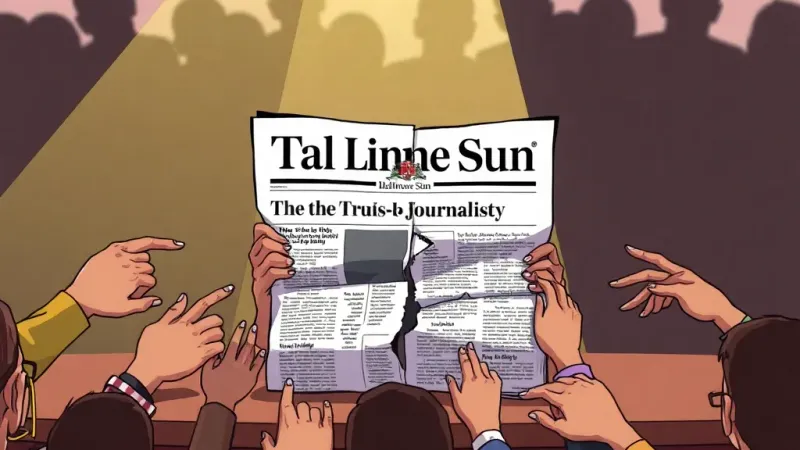
BALTIMORE – A crucial town hall meeting recently convened in Baltimore, drawing a diverse array of community stakeholders to confront the precarious future of The Baltimore Sun and the broader erosion of trust in journalism. The candid discussion underscored the profound challenges facing local news outlets nationwide, highlighting their vital role in civic discourse while grappling with financial instability and the pervasive spread of misinformation.
Held at the historic Enoch Pratt Free Library’s main branch, the event saw a packed auditorium eager to engage with the complex issues at hand. Attendees expressed deep concern over potential ownership shifts and the ongoing economic pressures that threaten the longevity of The Sun, a venerable institution serving Maryland for nearly two centuries. The dialogue extended beyond financial models, delving into the critical imperative for journalistic integrity and transparent reporting in an increasingly fragmented media landscape.
"We need The Baltimore Sun not just to survive, but to thrive as a beacon of truth in our community," stated Eleanor Vance, a retired history teacher and long-time city resident, her voice resonating with an urgency shared by many. "Who else will hold power accountable or tell our stories with the depth and nuance they deserve if not our local paper?" Her sentiment captured the palpable anxiety among citizens who rely on The Sun for critical local coverage, from municipal politics to neighborhood developments.
Media analyst Dr. Silas Thorne, an expert in local news sustainability, noted, "The challenges are multifaceted: declining advertising revenue, the digital migration of readers, and a concerted effort by some to sow distrust in legitimate news. For The Sun, like many legacy papers, innovation in digital platforms and a renewed focus on community-centric investigative journalism are paramount to rebuilding both its business model and its social contract." Thorne emphasized that rebuilding trust requires not only accurate reporting but also proactive engagement with the communities served.
Discussions at the town hall revolved around strategies to bolster The Sun's resilience, including exploring non-profit models, enhancing digital subscriptions, and fostering deeper connections with its readership through interactive initiatives. Participants also debated the role of citizens in supporting local journalism, suggesting community-funded projects and increased subscriptions as viable pathways. The overarching consensus pointed to the fact that a healthy democracy is intrinsically linked to a robust and trustworthy local press.
The evening concluded with a sobering reminder of the stakes involved. The future of The Baltimore Sun is not merely a corporate concern; it is inextricably linked to the health and vibrancy of Baltimore itself. As media landscapes continue to evolve, the collective will to support and defend credible journalism will dictate whether institutions like The Sun can continue to illuminate the path forward for their communities.