
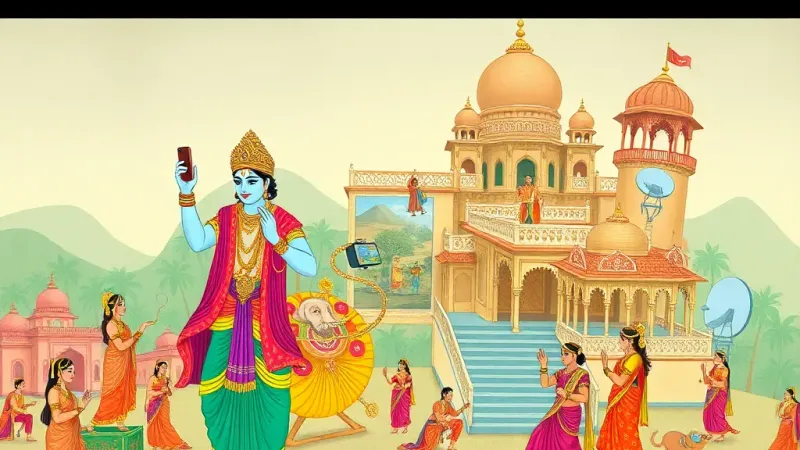
Rajasthan's latest cultural initiative, a series of expansive panoramas depicting key episodes from the ancient Hindu epic Ramayana, has captivated audiences, not just for its artistic grandeur but for a series of unexpected and anachronistic details that are sparking widespread amusement and discussion. Unveiled across several cultural centers, these installations aim to bring the epic to life for modern generations, yet some specific artistic choices have inadvertently introduced a layer of contemporary humor into the revered narrative.
One notable panorama, illustrating Lord Rama's exile, depicts the revered deity not in traditional footwear, but in what appears to be sleek, modern athletic shoes, complete with identifiable brand-like stripes. Another installation, focusing on the Pushpak Viman's journey, has adorned the mythological flying chariot with components strikingly similar to modern jet engines and a cockpit design reminiscent of a contemporary aircraft, far removed from its celestial description. Similarly, characters intended to represent ancient sages have been observed wearing spectacles that appear distinctly modern, almost indistinguishable from current optical frames.
These peculiar interpretations have not gone unnoticed by the scores of visitors flocking to witness the grand depictions. "It's certainly a unique way to bridge the gap between ancient stories and our modern world," commented Mr. Rajesh Kapoor, a local school teacher visiting with his family. "My children found it quite funny, pointing out Lord Rama's 'cool shoes.' While it deviates from traditional iconography, it undeniably sparks conversation." Dr. Anjali Sharma, a cultural historian specializing in Indian epics, offered a nuanced perspective. "While the intention is likely to make the epic relatable, such overt anachronisms risk undermining the historical and cultural authenticity many expect from such an ambitious project. However, it also highlights the dynamic nature of storytelling and interpretation across generations."
The project, initiated by the state's cultural department, was conceived as a vibrant, immersive educational tool, drawing inspiration from classical art forms while striving for accessibility. Official statements emphasized the goal of engaging a diverse audience, particularly younger demographics, by presenting the Ramayana's timeless values in an accessible format. The inclusion of these modern elements, whether intentional or the result of artistic liberty, has undeniably generated significant public discourse, far beyond typical cultural exhibits.
As the panoramas continue to draw crowds, the debate over artistic interpretation versus historical accuracy persists. For many, these unexpected details offer a refreshing, albeit unconventional, lens through which to view an ancient saga, proving that even in narratives thousands of years old, there remains room for surprise, amusement, and continuous re-imagining. The installations, therefore, serve as a testament to the enduring power of the Ramayana, capable of sparking both reverence and a hearty chuckle.


