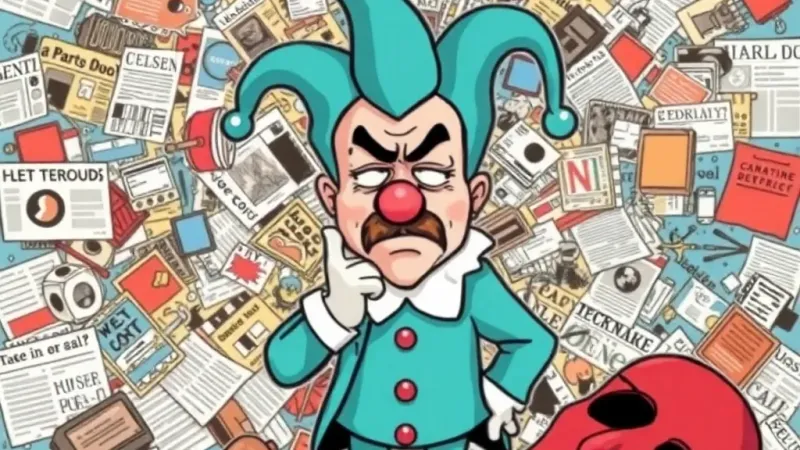
Political and social satirists worldwide are confronting an unprecedented challenge: the very fabric of reality appears to be outstripping their ability to mock it. What was once the fertile ground for comedic exaggeration has become a minefield where actual events frequently surpass the most outlandish fictional scenarios. This phenomenon is leading to a profound re-evaluation of satire's role and efficacy in contemporary society, with many practitioners finding their craft rendered almost obsolete by the daily headlines.
The core issue stems from an accelerating news cycle often characterized by unpredictable political developments, rapid cultural shifts, and a pervasive sense of disbelief among the populace. For decades, satirists honed their art by slightly distorting reality, pushing logical boundaries to expose absurdity or hypocrisy. Today, however, those boundaries are regularly shattered by genuine occurrences, leaving little room for comedic amplification. This erosion of the gap between the believable and the unbelievable has created a formidable creative block for many.
“It used to be that I could dream up the wildest scenario, and people would laugh, knowing it was an exaggeration designed to make a point,” stated Elara Vance, a veteran satirical columnist known for her sharp wit. “Now, I sketch out an idea, and by lunchtime, a real news story has emerged that makes my ‘far-fetched’ concept look utterly tame. It’s like reality itself decided to join the comedy writing room and then steal all the best punchlines.” Vance, like many of her peers, has found her traditional methods increasingly ineffective, leading to a period of professional uncertainty.
This shift has significant implications beyond the immediate professional concerns of satirists. When the line between genuine news and satirical commentary becomes blurred, public discourse suffers. The ability to discern truth from fiction, already strained by misinformation, is further complicated when reality itself often feels like a parody. Some analysts suggest that this era of 'un-satirizable' events reflects a deeper societal fragmentation, where shared understandings of normalcy and plausibility have fractured. The once-clear mirror of satire, designed to reflect society’s foibles, now finds itself struggling to distinguish between its own reflection and the bewildering landscape beyond the glass. The challenge for humorists now is not just to be funny, but to find new ways to cut through the noise when the noise itself is often the most absurd element in the room. This evolving dynamic underscores a critical moment for both comedic expression and the broader cultural conversation, demanding innovative approaches to make sense of an increasingly inexplicable world.