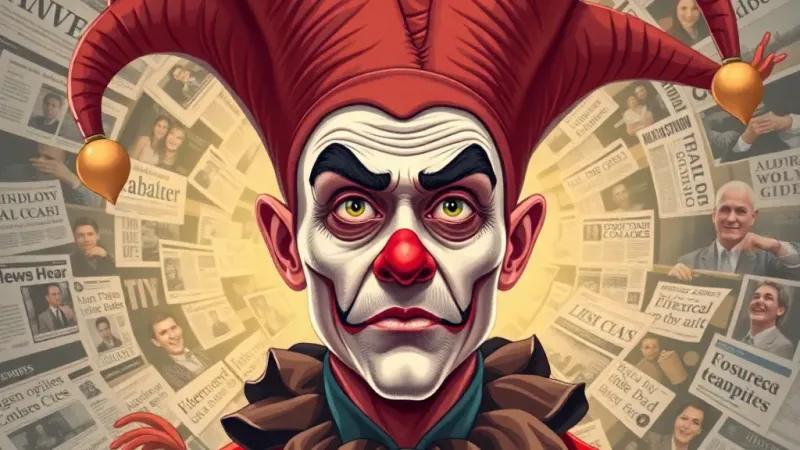
The realm of satire, long a critical lens through which society dissects its own absurdities, is confronting an unprecedented challenge: reality itself. Across newsrooms and comedy studios, writers specializing in comedic social commentary are reporting a growing obsolescence, as current events often defy or even surpass the wildest imaginings of their satirical plots.
This phenomenon marks a significant shift from traditional satirical dynamics, where humorists exaggerated societal flaws to expose deeper truths. Today, many find their punchlines pre-empted by actual headlines. "It used to be that we'd concoct some outlandish scenario to lampoon political figures or cultural trends," explains Anya Sharma, a former senior writer for a prominent satirical online publication. "Now, every morning, I wake up to news that sounds like something I would have drafted as an over-the-top sketch, only it's real, and it's happening. The line between parody and everyday life has evaporated."
This erosion of distinction has profound implications for the industry. Publications that once thrived on witty, biting critiques find their material redundant, or worse, indistinguishable from genuine news. The rapid, often chaotic, global news cycle presents a moving target that even the most agile satirists struggle to pin down. When reality itself becomes a caricature, the space for comedic exaggeration shrinks, leaving artists to grapple with the core purpose of their work.
Experts suggest this trend reflects a broader societal shift. Dr. Julian Vance, a media sociologist at the Institute for Contemporary Studies, notes, "Satire requires a baseline of shared understanding of what constitutes 'normal' or 'reasonable' to then subvert it. When that baseline becomes fluid, or when the 'unreasonable' becomes commonplace, the very foundation of satirical humor crumbles. It's a challenging time for truth-telling through humor when the truth itself often feels like a joke."
For many satirists, this isn't merely a creative block but an existential crisis for their profession. Some are pivoting towards more earnest commentary, while others are attempting to find new angles—perhaps focusing on the *reaction* to absurdity rather than the absurdity itself. The question remains whether satire can adapt to a world where its most potent tool, exaggeration, is no longer a unique artistic device but a daily news occurrence, forcing a redefinition of its role in an increasingly surreal landscape.