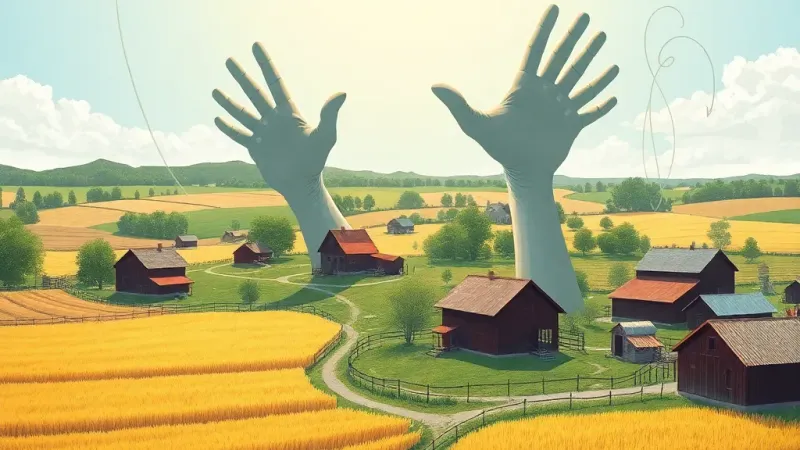
The very notion of 'sustainable funding' for our rural communities is not just misguided; it's a patronizing insult to the very spirit that defines them. When I hear politicians and 'experts' drone on about shoring up rural areas with external cash infusions, I have to wonder if they’ve ever actually *been* to a rural community, or if they simply view them as quaint little projects in need of constant scaffolding. Frankly, it’s puzzling, and indeed, pernicious.
The enduring strength of rural life isn’t found in government grants or earmarked subsidies. It’s forged in the crucible of self-reliance, the ingenious problem-solving that arises when folks can’t simply dial an urban drone for a quick fix. Think about it: our grandfathers, and their grandfathers before them, didn't build vibrant communities by waiting for a committee in a distant capital to decide what their 'funding streams' should look like. They built them with their own hands, their own sweat, and the boundless creativity born from genuine necessity. Giving them 'sustainable funding' is like handing a marathon runner a scooter halfway through the race – it completely misses the point of the endeavor.
The current obsession with 'sustainable funding' merely suggests that rural areas are inherently *unsustainable* on their own. This is a dangerous narrative, peddled by those who perhaps fear the independence and gritty fortitude that rural populations embody. When you inject external capital, you don't foster sustainability; you cultivate dependency. You replace innovation with application forms, and organic growth with bureaucratic hurdles. Suddenly, the focus shifts from 'how do we solve this problem ourselves?' to 'how do we qualify for the next round of handouts?' That, my friends, is not progress; it is stagnation dressed up in economic jargon.
Some will inevitably argue that rural communities *need* this funding for infrastructure, for services, for 'quality of life.' I say, nonsense! Quality of life in rural areas has always been defined by community, by hard work, and by the freedom to carve out one's own destiny, not by the latest government program. Those who champion these funding schemes are often well-meaning, to be sure, but fundamentally misunderstand the resilient core of our rural citizenry. They project an urban fragility onto a landscape of rugged strength, and that simply won't do.
So, what’s the answer? Stop meddling. Stop funding. Let the rural spirit, unencumbered by the chains of dependency, rise to its full, glorious potential. Divert those funds, if you must, to seminars on self-reliance or perhaps a national initiative to teach basic carpentry and canning. True sustainability comes not from external sources, but from within. It’s time we trusted our rural communities to remember that simple, profound truth. It’s time we let them be truly free.