
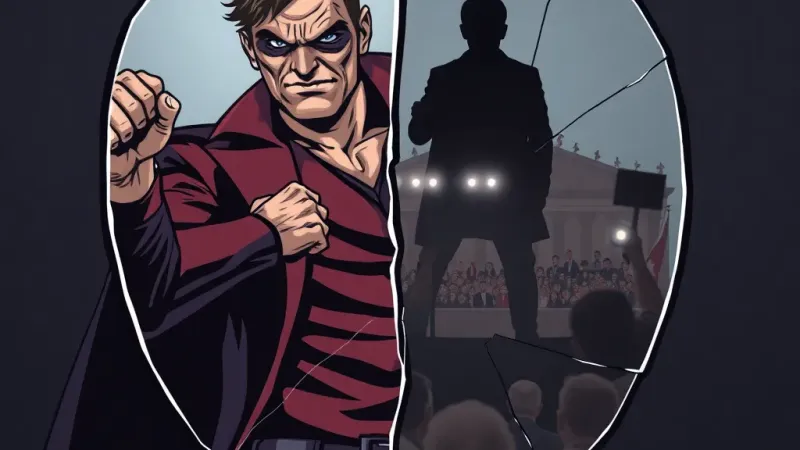
Hollywood is buzzing after a recent real-world political spectacle mirrored an audacious satirical moment from Amazon Prime Video’s hit series, “The Boys.” The uncanny resemblance, featuring a golden effigy, has prompted the show's creator, Eric Kripke, to acknowledge the unexpected overlap between the program's dark humor and contemporary political iconography.
The centerpiece of this bizarre convergence was unveiled at the recent Conservative Political Action Conference (CPAC) in Orlando, Florida. Attendees and observers alike were confronted with a roughly six-foot-tall, gilded statue of former President Donald Trump. Depicting the former leader in a stars-and-stripes-themed jacket, red shorts, and sandals, and clutching a magic wand, the figure immediately went viral, igniting both fervent praise and sharp criticism across social media platforms.
For fans of “The Boys,” the golden statue evoked immediate and startling déjà vu. The series, known for its scathing critique of superhero culture and corporate power, famously featured a similar, albeit fictionalized, golden statue of its narcissistic, fascistic superhero character, Homelander. This opulent, self-aggrandizing monument within the show was a clear symbol of unchecked power and hero worship, designed to satirize personality cults.
The show's creator, Kripke, shared his initial reaction to the real-world golden statue, expressing a mix of amusement and disconcerting familiarity. While not directly commenting on the political figure it represented, the observation underscored the often-thin line between dramatic satire and real-world absurdity. “It’s a peculiar phenomenon when art, intended to exaggerate societal trends, finds itself outpaced by reality,” remarked Dr. Lena Hanson, a professor of media studies at Sterling University. “Creators of satirical content frequently walk this tightrope, but moments like this highlight the increasing difficulty in distinguishing parody from genuine events.”
Indeed, the episode has reignited discussions about the role of satire in a hyper-polarized political landscape. “The Boys” has garnered critical acclaim for its fearless approach to contemporary issues, using its superhero narrative to dissect themes of corporate greed, political manipulation, and the dangers of blind idolization. The discovery of a real-life parallel, so strikingly similar to one of its most pointed visual gags, serves as a stark reminder of the show’s perceptive, if darkly humorous, commentary on modern society. The incident reinforces the idea that sometimes, reality can be stranger, and perhaps more illustrative, than even the most imaginative fiction.


