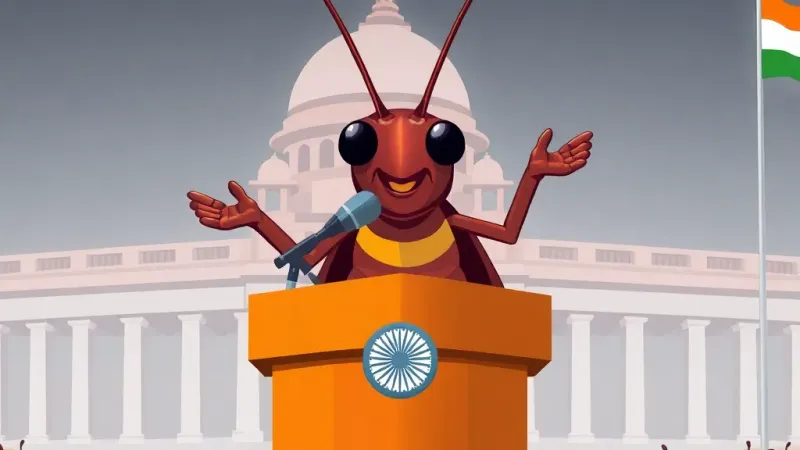
NEW DELHI – India's often tumultuous political landscape has witnessed the emergence of a novel and highly satirical entity: the 'Cockroach Janta Party' (CJP). Formed in direct response to recent remarks by Chief Justice of India (CJI) Surya Kant, the fledgling outfit has quickly drawn significant public attention, amplified by an endorsement from prominent Trinamool Congress (TMC) leader Mahua Moitra, who publicly declared her desire to join its ranks.
The CJP’s inception follows widespread public discourse surrounding observations made by CJI Kant, which some interpreted as dismissive of certain legal petitions and the concerns they represented. The 'cockroach' metaphor, quickly seized upon by political satirists and commentators, became a poignant symbol of perceived societal marginalization and bureaucratic indifference, crystallizing into a full-fledged, albeit mock, political organization.
Helmed by self-proclaimed chief ideologue and political satirist, Ramesh Kumar, the CJP's satirical manifesto aims to spotlight issues of perceived political apathy and the struggles of the common citizen. "Our party's core mission is to infest the corridors of power with uncomfortable truths, much like the resilient cockroach navigates unseen cracks," stated Kumar in an online press release. "We aim to amplify the voices that are often swatted away, turning contempt into compelling commentary on governance and justice."
The CJP's formation has resonated widely, with social media platforms abuzz with reactions. The most notable came from Mahua Moitra, a vocal critic of the current administration, who tweeted, "I too would like to join CJP!" Her immediate backing lends an unexpected gravitas to the satirical venture, elevating it from a niche online phenomenon to a significant talking point within mainstream political circles. Dr. Ananya Sharma, a renowned political commentator based in Mumbai, observed, “Moitra’s endorsement is a powerful indicator of the current mood. When satire becomes this potent, it reveals a profound dissatisfaction that traditional political discourse might not be addressing adequately. It's a barometer of public sentiment, albeit delivered with a sharp, ironic wit.”
Beyond the immediate political banter, the 'Cockroach Janta Party' serves as a stark reflection of the growing role of humor and irony in Indian dissent. It underscores a creative shift in public engagement, where mockery is employed not just for entertainment but as a critical tool to challenge authority and spark vital conversations. As the CJP continues to 'crawl' across news feeds and political discussions, it reinforces the enduring power of satire to hold a mirror to society and its leaders.