
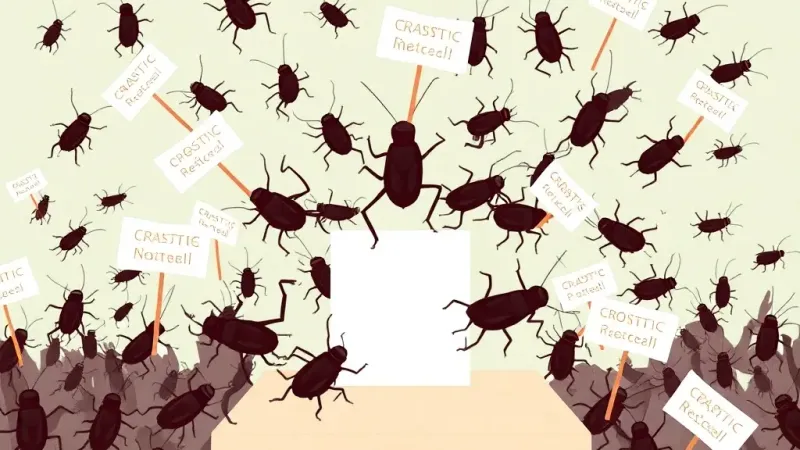
MUMBAI, India – A peculiar yet potent satirical political movement, self-dubbed the "Cockroach Army," has begun to make significant ripples across India, utilizing the ubiquitous and resilient insect as a searing metaphor for its sharp critique of persistent governance challenges. What began as a series of anonymous online posts and street art in urban centers has rapidly evolved into a discernible cultural phenomenon, capturing the public imagination with its blend of absurdity and pointed social commentary.
The movement's central motif, the cockroach, is intentionally provocative. Proponents argue it symbolizes the common person's remarkable ability to survive despite difficult conditions, as well as the pervasive, often-ignored issues that persist within society’s fabric. These “cockroaches” thrive in the unaddressed corners of bureaucracy, corruption, and systemic inefficiency, issues the movement aims to drag into the harsh light of public scrutiny. Their tactics involve viral social media campaigns, public art installations featuring oversized cockroach cutouts strategically placed near government buildings, and impromptu street theatre that mimics bureaucratic foibles with darkly comedic flair.
"We are the 'cockroaches' of society, seemingly small and insignificant, yet we endure everything thrown at us and multiply," declared a masked individual identifying as 'Kiran,' a self-proclaimed spokesperson for the movement during a recent online press conference originating from Bengaluru. "We expose what others wish to sweep under the rug, highlighting the tenacity of ordinary citizens in the face of indifference and the 'infestations' that plague our systems." The movement claims to represent the voice of those who feel overlooked and marginalized, channeling their frustrations through the unexpected lens of entomological symbolism.
Political analysts are observing the rise of the "Cockroach Army" with interest, noting its distinct departure from traditional forms of protest. "This movement, while unconventional, taps into a deep well of public frustration through humor and allegory," observed Dr. Ananya Sharma, a political sociologist at Delhi University. "It allows citizens to voice dissent in a way that is both memorable and less confrontational, circumventing typical political narratives and reaching a younger, digitally native audience effectively." Dr. Sharma highlighted the psychological impact of such satire, which can often be more potent than direct confrontation in shaping public opinion and fostering collective identity among disaffected groups.
While largely satirical and without formal political affiliations, the "Cockroach Army" is proving to be a potent mirror reflecting societal anxieties. Its growing visibility underscores a shift in how political critique is being articulated in the world's largest democracy, demonstrating the enduring power of symbolism and satire to engage the populace and challenge the status quo, one viral meme and giant insect cutout at a time. The sustained buzz around this unlikely phenomenon suggests that India's political discourse may be in for an enduring, albeit unconventional, infestation of critical thought.


