
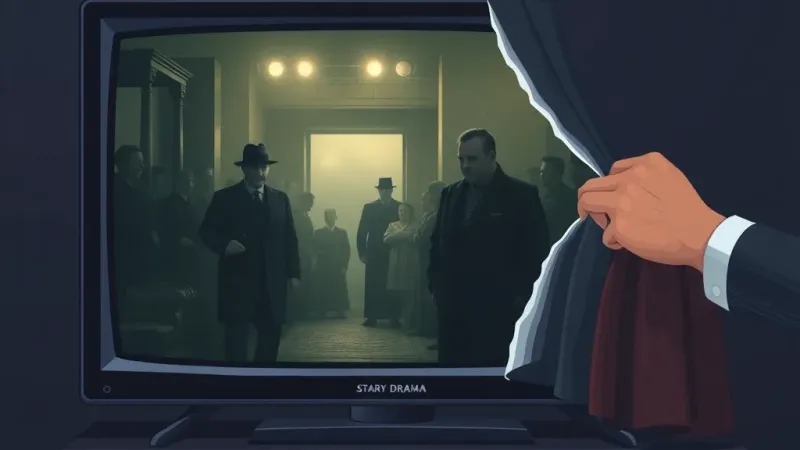
Séamas O’Reilly, the celebrated Irish writer and satirist, has unveiled his latest literary offering, "Prestige Drama," a critically acclaimed work that sharply yet warmly dissects the often-melodramatic and reductive television portrayals of The Troubles. Released to significant anticipation, the book navigates the fraught landscape of Northern Irish history through a comedic lens, aiming to expose the superficiality that can accompany high-budget productions seeking to dramatize one of the most complex periods in recent Irish memory. O’Reilly's unique brand of humour, known for its intellectual depth and emotional resonance, promises readers a thoughtful deconstruction of narrative tropes that have, for decades, shaped public perception.
The novel meticulously skewers familiar elements prevalent in these "prestige" series: the perpetually brooding protagonists, the overly earnest attempts at moral ambiguity, the heavy-handed symbolic gestures, and the ubiquitous, atmospheric grey skies. O’Reilly expertly highlights how these dramaturgical choices, while often visually compelling, frequently sacrifice authentic lived experience for sensationalism. From the predictable sectarian stand-offs to the tokenistic inclusion of "both sides" without genuine exploration, "Prestige Drama" holds a mirror to the genre, questioning whether television, in its quest for dramatic tension, truly serves the historical record or merely repackages trauma for entertainment.
Critics have widely praised O’Reilly’s courage and wit in tackling such a sensitive subject with satire. Dr. Alistair Finch, Professor of Media Studies at the University of Dublin, noted, "O'Reilly's work arrives at a crucial juncture, inviting us to critically re-evaluate how historical events, particularly those as raw as The Troubles, are consumed as entertainment. It's a testament to his skill that he can provoke laughter while simultaneously fostering profound reflection on media ethics." The book challenges audiences to look beyond the slick production values and question the underlying messages and simplifications.
O’Reilly’s motivation, it appears, stems not from a desire to trivialise the profound suffering associated with The Troubles, but rather to reclaim some of the narrative agency from those who might inadvertently flatten its complexities. By exaggerating the familiar clichés, he empowers readers to recognize and critically engage with the common pitfalls of historical dramatisation. His writing maintains a respect for the genuine human impact of the conflict, ensuring that the satire serves as a vehicle for deeper understanding, rather than an exercise in cynical mockery. This nuanced approach has resonated strongly with early readers, many of whom have expressed relief at seeing these narratives gently, yet firmly, dismantled.
"Prestige Drama" stands as more than just a comedic novel; it is a significant cultural commentary that contributes to an ongoing dialogue about memory, representation, and the media's role in shaping historical consciousness. Its publication prompts a valuable introspection into how stories from difficult pasts are told and received, both locally and internationally. As O’Reilly invites us to laugh at the absurdities of fictionalised history, he also compels us to demand greater authenticity and depth from future productions seeking to illuminate the intricate tapestry of human experience during tumultuous times, ultimately fostering a more informed and discerning viewership.


