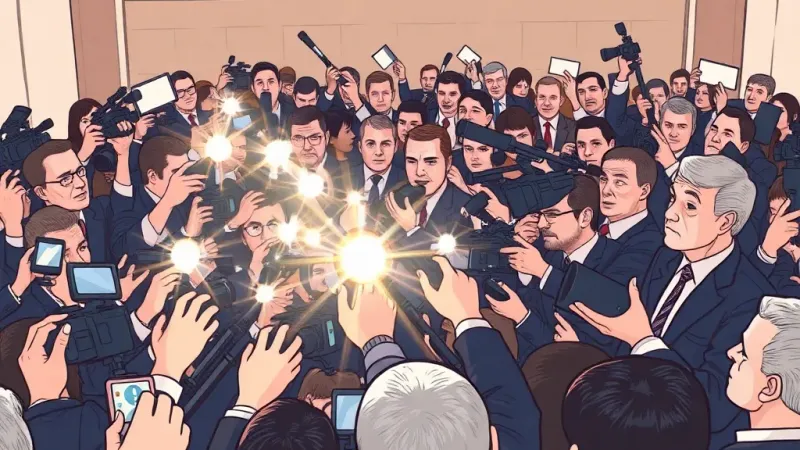
A single gunshot report near a high-profile political fundraising dinner featuring former President Donald Trump on Tuesday evening sent immediate ripples of alarm through the event and its security detail, igniting a swift response from law enforcement and drawing sharp criticism regarding the subsequent media presence. The incident, which occurred just outside the perimeter of the exclusive Westmont Grand Ballroom, prompted an instant lockdown and a massive deployment of emergency services, even as journalists rapidly converged to document the unfolding scene.
The exact circumstances of the discharge remain under investigation by local authorities, who have confirmed that no direct threat was posed to the former President or attendees inside the venue. The shot, believed to have been an isolated incident unconnected to the event, caused no injuries and appears to have stemmed from an accidental discharge or a separate, minor altercation unrelated to the political gathering. Despite the swift containment and the benign nature of the event's cause, the sound itself triggered protocols designed for serious security breaches, underscoring the high-stakes environment surrounding such prominent figures.
As uniformed officers and plainclothes security personnel established a secure perimeter, dozens of journalists and videographers descended upon the area. Equipped with cameras, microphones, and satellite uplinks, they began filming the evolving situation, capturing images of anxious attendees being escorted from the building, the intense law enforcement activity, and the general confusion that pervaded the immediate aftermath. This rapid and often intrusive documentation, however, was not without its detractors.
Eleanor Kirkwood, a security consultant involved with the event’s logistics, vocalized strong disapproval of the media’s actions. "There's a critical difference between reporting the news and actively creating a spectacle out of a sensitive security situation," Kirkwood stated emphatically from a cordoned-off observation point. "The moment a firearm is discharged near a high-profile individual, the priority must be public safety and operational security. Filming distressed individuals, potentially interfering with emergency personnel, or broadcasting unverified details can escalate panic and compromise safety measures." Her remarks reflect a growing sentiment among event organizers and some members of the public concerning the perceived overreach of news crews in crisis scenarios.
Conversely, representatives from the journalistic community defended their presence, citing the public’s right to information and the essential role of the press in transparently documenting events of national significance. "Our responsibility is to report what transpires, especially when it involves public figures and security incidents," remarked Marcus Thorne, a spokesperson for the National Press Guild. "While respecting privacy and operational needs is paramount, so is providing factual, immediate coverage to counteract misinformation and keep the public informed. This means being on the ground, even when situations are fluid."
The incident and its subsequent media coverage have reignited a familiar debate within both journalistic circles and public forums about the ethical boundaries of reporting during emergencies. While authorities continue their investigation into the origins of the gunshot, the broader discussion on the balance between press freedom and the imperative for calm and security remains firmly in the spotlight, highlighting the ongoing tension between these crucial societal roles.