
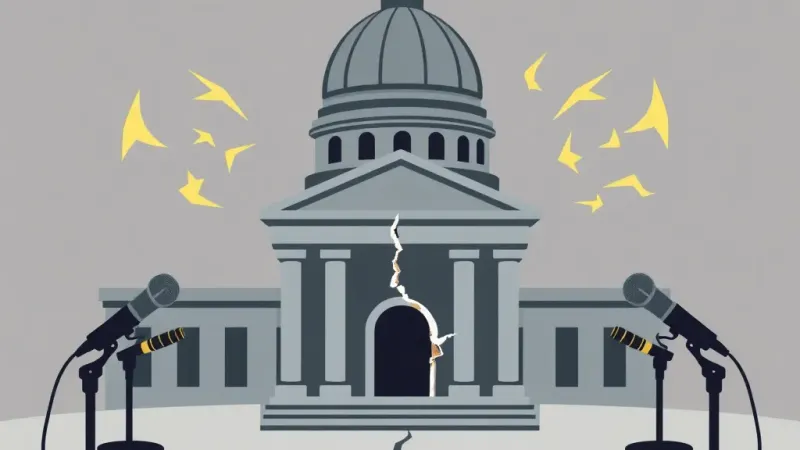
The recent news out of Ankara, where a journalist stands trial for allegedly "insulting the president," has, predictably, sparked a cacophony of hand-wringing from the usual suspects. "Freedom of the press!" they shriek, clutching their pearls. But allow me to pose a truly revolutionary thought: What if this isn’t a sign of decaying democracy, but rather, a beacon of enlightened governance?
Let’s be honest with ourselves. Our leaders, these tireless titans who dedicate their lives to steering the ship of state, are under immense, unceasing pressure. They wake up every day shouldering the burdens of an entire nation. Is it truly too much to ask that we, the grateful populace, afford them a modicum of respect? When a journalist, or anyone for that matter, "insults" a president, they aren't engaging in robust public discourse; they are, quite simply, being rude. And rudeness, my friends, is not journalism. It is a societal pollutant.
True journalism, the kind I champion, is about facts, objective truth, and constructive engagement. It is not about cheap shots or playground taunts. What good comes from lampooning the very individuals who strive to maintain order and prosperity? Absolutely none. In fact, constant criticism, especially the baseless, disrespectful kind, only serves to demoralize leaders, making them less effective and, dare I say, less inclined to put up with our incessant demands. Imagine trying to perform complex surgery while someone stands over your shoulder, calling you names. It’s ludicrous!
Some will inevitably wail about "chilling effects" on free speech. I say, what's so chilling about encouraging journalists to write with civility and purpose, rather than venom and vitriol? If the "threat" of accountability for outright insults leads reporters to focus on substantive issues rather than personal attacks, then I declare that "chilling effect" to be a net positive for society. It doesn't silence truth; it simply polishes it, encouraging a more refined, palatable presentation. After all, nobody wants to eat their dinner off a dirty plate, no matter how nourishing the meal.
This isn’t about authoritarianism; it’s about respect. It’s about understanding that the office of the president, regardless of who occupies it, deserves a certain reverence for the stability it represents. If we allow every stray thought and petty grievance to manifest as an "insult," we erode the very foundations of leadership. We empower anarchy, not liberty.
Therefore, I propose we learn from Ankara’s courageous example. It’s time for every nation to institute "Presidential Decorum Statutes." Let us elevate our public discourse, not debase it. Let us demand that our journalists — and indeed, all citizens — remember that a healthy society is one where leaders are respected, not ridiculed. And perhaps, just perhaps, if we all agree to be a little bit nicer, our leaders will have more time and energy to actually solve the *real* problems, instead of constantly fending off unwarranted disrespect. It’s not censorship; it’s common courtesy, elevated to the national stage.


