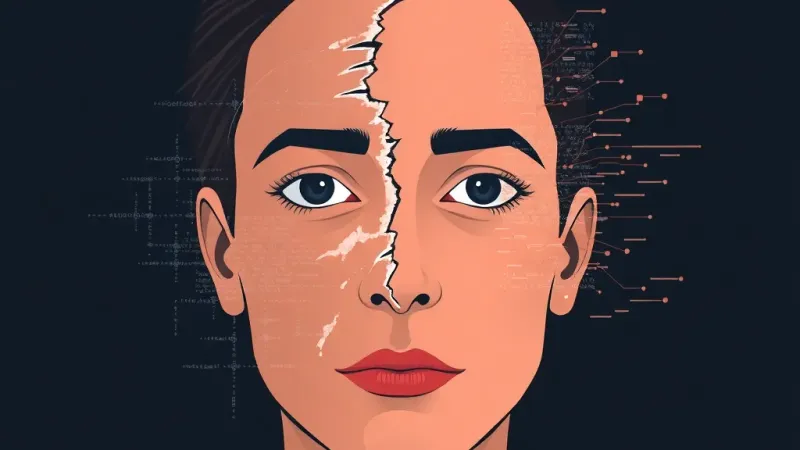
The digital landscape is increasingly being reshaped by a potent and deceptive technology known as deepfakes, sophisticated artificial intelligence-generated media that blurs the lines between reality and fabrication. These creations leverage advanced machine learning algorithms to produce highly realistic images, audio, and video, making it appear as though individuals are saying or doing things they never did. The rapid evolution of deepfake technology presents an unprecedented challenge to truth and trust in an interconnected world, fueling concerns over widespread misinformation, elaborate fraud, and the erosion of public confidence in verifiable information.
At their core, deepfakes are typically generated using a class of AI models called Generative Adversarial Networks (GANs). A GAN comprises two neural networks: a generator that creates synthetic content and a discriminator that attempts to distinguish between real and fake data. Through a continuous feedback loop, the generator refines its output to trick the discriminator, while the discriminator improves its ability to identify forgeries. This adversarial process yields increasingly convincing fakes, capable of seamlessly superimposing one person's face onto another's body in a video, or synthesizing an individual's voice with uncanny accuracy from minimal audio samples. The accessibility of sophisticated tools, once confined to specialized researchers, is now extending to a broader range of users, amplifying the potential for misuse.
The implications of widespread deepfake proliferation are profound and multifaceted. In the political arena, deepfakes could be weaponized to create fabricated speeches or compromising videos of public figures, potentially swaying elections, inciting unrest, or undermining diplomatic relations. Financial institutions and individuals face heightened risks of fraud, where voice deepfakes could trick authentication systems or deceive employees into transferring funds. Beyond these critical sectors, the technology poses severe threats to personal reputation, with individuals becoming targets of non-consensual sexually explicit content or defamatory fabrications. "The fundamental threat of deepfakes isn't just the deception itself, but the broader crisis of trust it precipitates," stated Dr. Evelyn Reed, a leading digital ethics researcher at the Institute for Digital Integrity. "When you can no longer believe what you see or hear, the very bedrock of informed discourse crumbles."
Efforts to combat deepfakes are intensifying, with researchers developing new detection algorithms designed to identify subtle artifacts or inconsistencies often present in synthetic media. However, this creates an ongoing "arms race," as deepfake creators continuously refine their techniques to evade detection. The battle against digital deception also necessitates a significant uplift in media literacy among the general public, empowering individuals to critically evaluate online content and recognize potential manipulations. While some proponents highlight benign applications, such as film post-production, historical reenactments, or assisting individuals with communication disabilities, the current public discourse is largely dominated by concerns over malicious intent. The imperative now lies in fostering robust technological countermeasures alongside comprehensive educational initiatives and perhaps, eventually, legislative frameworks, to safeguard the integrity of our shared digital reality.