
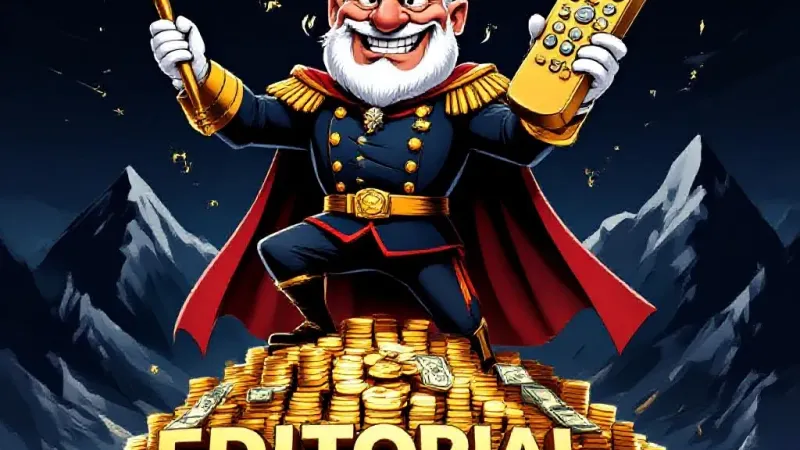
The digital media landscape continues its evolutionary march, often finding venerable publications serving new, increasingly opaque functions. Case in point: TheWrap, a publication generally focused on the business of entertainment, recently dedicated editorial space to recommend "The 3 Best Movies to Watch on Netflix This Week." Led by the film "Hamnet," this piece epitomizes a prevalent trend where media outlets, once arbiters of original reporting and criticism, now frequently act as unpaid content curators for major streaming platforms. The shift is subtle but significant, moving from *reporting on* the industry to *promoting content within* the industry, often for entities with vastly greater financial and distribution power.
This reorientation of editorial priorities is not accidental; it is a direct consequence of the prevailing attention economy. In an ecosystem where every click represents potential ad revenue, and every search query a pathway to traffic, publishers are compelled to optimize for visibility. Crafting lists of popular movies on a platform like Netflix — a service with over 260 million global subscribers — guarantees a steady stream of search traffic. It’s a low-cost, high-return content strategy, at least in terms of raw page views. The implicit bargain is clear: a publisher trades a sliver of its editorial independence for algorithmic favor and the attention of an audience already primed to consume.
However, the asymmetry of this relationship bears scrutiny. Netflix, a multi-billion-dollar enterprise, receives free, editorially framed promotion from a respected industry publication. This effectively offloads part of its content discovery and marketing burden onto an external entity. For TheWrap, the immediate benefit is traffic. Yet, the broader implication is that resources that could be allocated to investigative journalism, in-depth analysis of industry trends, or original criticism are instead deployed to guide subscribers through an existing content library. The critical distinction between journalism and promotional content blurs further, contributing to a general erosion of trust in an already fractured media environment.
This dynamic extends beyond specific movie recommendations. From "best of" lists for various streaming services to aggregated news feeds on social platforms, the media industry is increasingly becoming a processing plant for information originating elsewhere. Original reporting, particularly the kind that requires significant investment in time and resources, often struggles to compete with the algorithmic amplification afforded to content that merely points users to another platform's offerings. While audiences may appreciate the convenience, the long-term cost to the independent media landscape, and its ability to hold power accountable, remains unquantified and largely unacknowledged by the platforms that benefit most.
In essence, a publication like TheWrap, by engaging in such content, implicitly validates a system where its editorial judgment is leveraged to serve the engagement metrics of a platform whose primary interest is subscriber retention. The "best movies" list, in this context, is less about critical discernment and more about operational efficiency in the attention market: how to best funnel eyeballs from one digital destination to another, all while maintaining the veneer of independent editorial curation.