
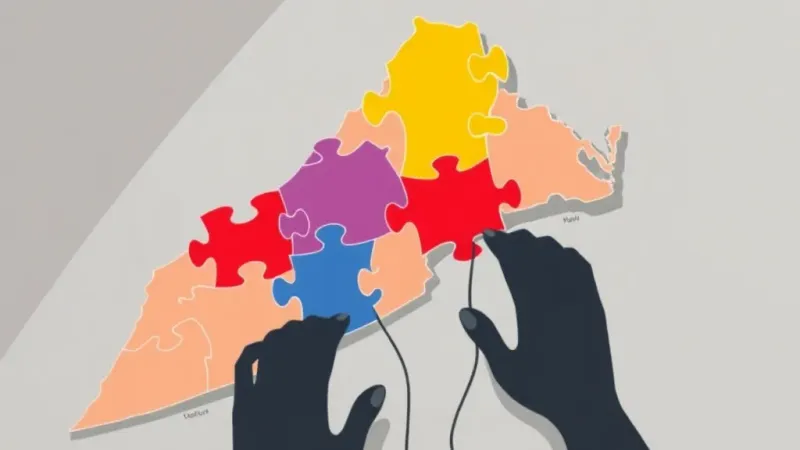
RICHMOND, VA – Virginia voters have approved a constitutional amendment establishing a bipartisan redistricting commission, a move widely touted by proponents as a significant step towards mitigating partisan gerrymandering. However, despite its passage, a chorus of critics and political observers warns that the new system may represent a 'lesser threat' rather than a definitive solution, leaving substantial room for political maneuvering and potential deadlock.
The referendum, which garnered considerable support, aims to replace the previous system where the General Assembly alone drew electoral maps. Under the new framework, a 16-member commission—comprised of eight legislators and eight citizens—will be tasked with proposing new district lines every ten years. For a map to be adopted, it must receive approval from at least six legislative members and six citizen members, as well as a majority vote in both chambers of the General Assembly.
The core of the apprehension centers on the commission's perceived lack of true independence. Critics argue that the process of selecting citizen commissioners remains indirectly influenced by legislative leadership, thereby maintaining a partisan tether. Furthermore, the requirement for legislative approval of the commission's proposed maps grants lawmakers a powerful veto, potentially forcing the commission to yield to partisan demands to avoid impasse.
“While any reform effort is commendable in spirit, this particular amendment leaves too many pathways for political actors to continue shaping maps for their own benefit,” stated Dr. Evelyn Reed, a seasoned political science researcher at the Commonwealth Institute for Policy Studies. “The intent to create an impartial process is evident, but the structure itself retains inherent vulnerabilities to partisan deadlock and undue influence.”
Should the commission fail to reach an agreement, or if the General Assembly rejects its proposals, the ultimate authority to draw the maps will fall to the Virginia Supreme Court. This provision, while intended as a fail-safe, has also drawn scrutiny. Opponents contend that involving the judiciary in such a politically charged process could inadvertently politicize the courts themselves, eroding public trust in judicial impartiality.
“Many of us voted for this reform expecting a truly independent body to draw fair maps,” commented Mr. Samuel Jenkins, a long-time advocate for electoral transparency from Fairfax County. “We hoped for a clean break from partisan mapmaking, but the devil, as they say, is in the details. It feels like we’ve traded one set of problems for another, albeit potentially smaller, set.”
The passage of the referendum undeniably reflects a strong public desire for more equitable electoral maps. Yet, as Virginia embarks on this new redistricting journey, the foundational debate over how effectively this 'reform' will truly depoliticize the map-drawing process is only just beginning. The coming decade will test the resilience of this new commission against the entrenched forces of partisan politics.


