
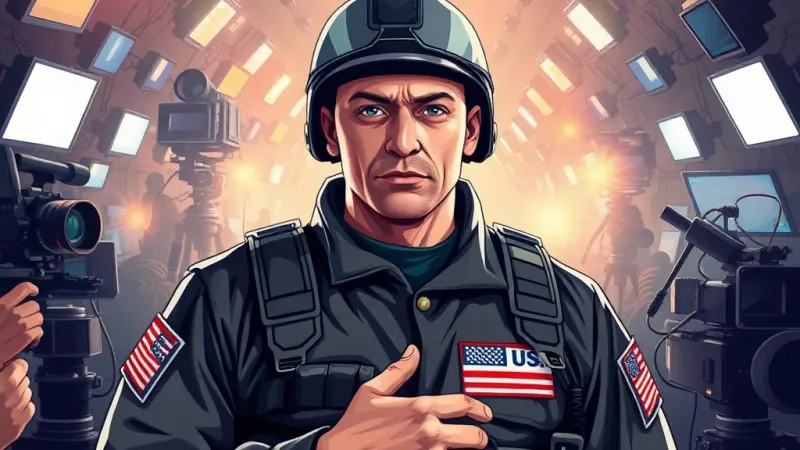
The retrieval of a downed U.S. airman, while a legitimate news event of significant interest, has been presented by considerable portions of the press as a “daring,” “dramatic” mission, critics observe, adhering more closely to the narrative arcs of a Hollywood action film than objective journalism. This pattern of coverage, highlighted by media analysts, risks distorting public understanding of military operations and the complex geopolitical landscapes in which they occur.
News outlets widely employed evocative language, portraying the mission as a high-stakes endeavor featuring brave rescuers and clear antagonists. Headlines often championed the “heroic” efforts of special forces, while any opposing forces or contextual complexities were frequently reduced to a monolithic “villain” stereotype. This dramatic license, while potentially boosting readership, has raised pertinent questions about journalistic integrity and the public's access to nuanced information.
Media watchdog groups and academic observers have highlighted how such sensationalized reporting can inadvertently serve as propaganda, shaping public opinion in a predetermined direction. “The urgency to craft a compelling storyline often overshadows the duty to provide comprehensive context,” noted Dr. Evelyn Reed, a professor of media studies at the Metropolitan University. “When every rescue becomes an epic saga, the lines between reporting and storytelling blur, potentially leading to an oversimplified view of intricate international relations.”
On Main Street, the perception often mirrored the headlines disseminated across various platforms. “It felt like watching a movie unfold live,” commented local resident, Mr. Thomas Albright, an avid news consumer. “You were just waiting to see if our guys would make it out against all odds, just like in the films.” This sentiment underscores the effectiveness of the media's narrative choices in gripping the public imagination and shaping its interpretation of events.
This framing also tends to gloss over the broader implications of military presence and conflict, focusing instead on individual acts of bravery. While individual heroism is undoubtedly a component of military service, critics argue that an exclusive focus on these elements can obscure the costs and controversies associated with extended military engagements. The reliance on cinematic tropes – the ticking clock, the clear objective, the ultimate triumph – transforms complex geopolitical events into easily digestible, emotionally resonant spectacles.
This approach stands in contrast to journalistic principles advocating for balanced reporting, context, and a dispassionate examination of facts. The incident serves as a stark reminder of the power of media narratives and the imperative for news organizations to resist the siren call of dramatic simplification in favor of rigorous, comprehensive reporting. Ensuring that the public receives a full, unvarnished account of events, even those involving profound danger and bravery, remains paramount.


