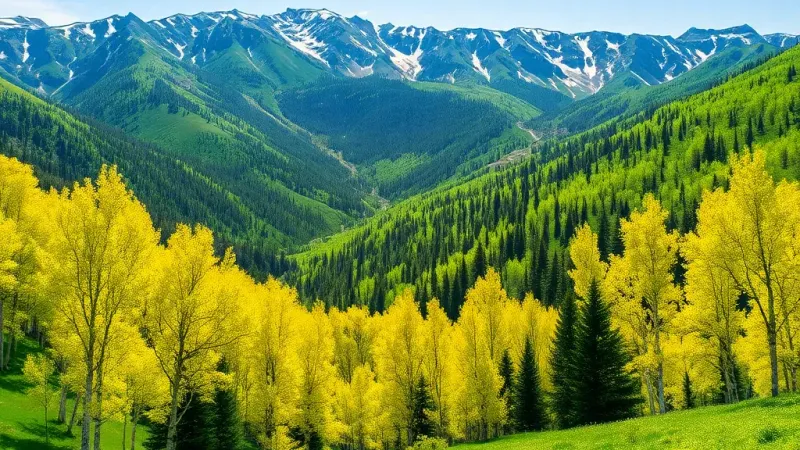
Wyoming's high-altitude plains and mountain foothills are experiencing an unprecedented acceleration of spring's arrival. Observations across the state, from the iconic Grand Teton National Park to the vast expanses near Casper, indicate that aspen trees are bursting forth with their characteristic lime-green leaves, and numerous perennial plants are sending up shoots weeks ahead of their historical averages. Typically, this verdant transformation doesn't occur until late May or early June in many regions.
According to data compiled by the Wyoming Climate Office, March saw average temperatures nearly five degrees Fahrenheit above the long-term mean, contributing to rapid snowmelt and earlier soil warming. Dr. Elias Vance, a senior climatologist at the Wyoming Institute for Environmental Research, emphasized the significance of these shifts. 'What we are witnessing is a pronounced phenological shift, where the biological timing of natural events is advancing significantly,' Dr. Vance stated. 'This isn't merely an 'early spring'; it represents a measurable deviation from established ecological rhythms that have profound implications for our state's biodiversity and agricultural sectors.'
The primary concern among environmental scientists is the vulnerability of this premature growth to subsequent late-season frosts, which could severely damage or kill tender young foliage, impacting tree health and forest productivity for the entire season. Furthermore, the early flush of vegetation can create a mismatch for migrating wildlife, such as elk and deer, whose calving seasons and migratory patterns are often synchronized with the traditional availability of fresh forage.
Ms. Clara Jenkins, a botanist who has documented flora in the Wind River Range for over three decades, recounted her observations. 'I observed aspen stands fully leafed out near Dubois in mid-April, a sight I'd typically expect well into May,' Jenkins noted. 'It's a beautiful spectacle, but it also carries an underlying unease about the stability of our ecosystem in the face of such rapid change.'
State wildlife and parks agencies are collaborating with academic institutions to intensify monitoring efforts, employing advanced satellite imagery alongside traditional ground surveys to quantify the extent and long-term impacts of these accelerated seasonal shifts. This early awakening of Wyoming's natural landscape serves as a compelling indicator of broader environmental transformations, underscoring the urgent need for continued scientific inquiry and adaptive management strategies to safeguard the state's unique ecological heritage.