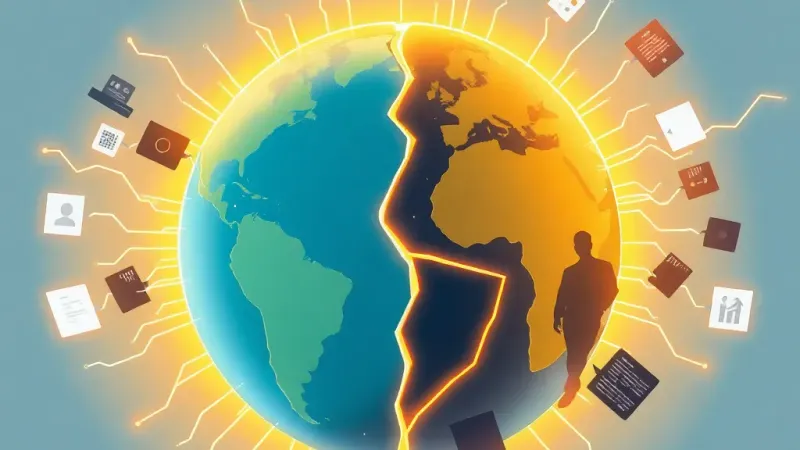
A groundbreaking study led by researchers at the University of Oregon, published this week in the prestigious journal Nature, has revealed a significant and troubling phenomenon: the pervasive influence of state-controlled media environments directly skews the answers provided by advanced artificial intelligence models across numerous languages. The findings indicate that AI systems, designed to process and generate human-like text, inadvertently absorb and reflect the geopolitical biases prevalent in the information ecosystems they are trained on, raising profound questions about the impartiality of AI as a global information source.
The multi-institutional research team meticulously analyzed responses from leading large language models (LLMs) to hundreds of queries spanning politically sensitive topics, historical interpretations, and contested social issues. They specifically targeted questions where narratives diverge significantly between countries with free press and those with heavily state-controlled media. Across 20 distinct languages, including Mandarin, Russian, Arabic, and Farsi, the study observed a consistent pattern: AI-generated answers in languages prevalent in regions with stringent state media control often mirrored the official government stance, even when presented with questions designed to elicit a neutral or balanced perspective. This divergence was quantified using a newly developed "information bias index," which scored AI responses against a baseline of independently verifiable facts and narratives from open societies.
To ascertain this bias, researchers crafted a sophisticated methodology, cross-referencing AI outputs with established global press freedom indices and human-annotated datasets representing diverse geopolitical viewpoints. "We weren't just looking for isolated instances; we uncovered a systemic assimilation of state narratives," stated Dr. Alistair Vance, a lead author from the University of Oregon's Department of Computer Science, emphasizing the study's robust statistical significance. "These AI models, acting as complex cultural mirrors, reflect the information diets fed to them, making them unwitting propagators of specific ideologies if their training data is predominantly sourced from restricted environments." The study involved testing over a dozen commercially available and open-source LLMs, revealing the issue is not confined to a single architecture but is a systemic challenge across the AI landscape.
The implications of these findings are far-reaching. As AI becomes an increasingly integral tool for information retrieval, education, and decision-making, its inherent biases pose a substantial risk to the pursuit of objective truth and cross-cultural understanding. For individuals relying on AI for news or research, particularly in multilingual contexts, the potential for encountering skewed or propagandistic information is heightened. This phenomenon complicates efforts to deploy AI ethically and equitably on a global scale, suggesting a need for more diverse and carefully curated training data, or at least transparent disclaimers regarding potential biases. The researchers note that simply training on larger datasets may not mitigate the issue if those datasets are themselves unrepresentative of global information freedom.
Experts are calling for urgent attention from AI developers and policymakers alike. Mr. Ben Carter, an independent AI ethics consultant not involved in the study, commented, "This study serves as a critical wake-up call. We've long discussed algorithmic bias, but seeing it manifest so clearly along geopolitical lines, influenced by state media, adds a new, complex layer to the challenge of building truly objective and beneficial AI." The research team suggests future work could involve developing bias detection mechanisms within AI systems themselves or creating specialized training regimens designed to actively counteract geopolitical information skew, ensuring that AI can serve as a conduit for open information rather than an amplifier of restricted narratives.