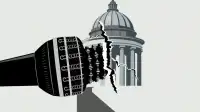
Former Chicago Tribune editor James O'Shea has weighed in on the contemporary state of American journalism, articulating a critique that resonates with long-standing concerns about the industry's institutional practices. O’Shea, who previously oversaw political coverage at the Tribune and served as editor of the Los Angeles Times, posits that a significant portion of the press has retreated into a form of reporting that prioritizes transcription over critical analysis, inadvertently undermining its democratic function.
His assertion that "You don’t get a lot of complaints if you just write down what everyone says and leave it at that" cuts to the core of a pervasive journalistic habit. This approach, often misconstrued as objective reporting, manifests as a strict adherence to the "he said, she said" paradigm. While appearing balanced on the surface, this method frequently results in a presentation of conflicting claims without sufficient context, verification, or critical scrutiny of power dynamics and factual accuracy. The consequence, as O'Shea implies, is a journalistic output that may satisfy a procedural definition of neutrality but fails to equip the public with the necessary tools to discern truth from spin.
The operationalization of such a cautious, complaint-averse editorial philosophy can be attributed to several factors inherent in the modern media landscape. Economic pressures have led to diminished newsroom resources, pushing journalists to cover more ground with less time for deep investigation. The rise of social media and the 24/7 news cycle further incentivize speed over depth, creating an environment where the fastest aggregation of official statements often takes precedence. Moreover, the historical development of "objectivity" as a professional norm, while initially intended to foster trust, has sometimes calcified into a defensive posture, where challenging powerful narratives is deemed risky.
This institutional reluctance to move beyond the superficial often leaves the public adrift in an ocean of undifferentiated information. When news organizations merely parrot official statements or present partisan talking points without robust interrogation, they inadvertently legitimize misinformation and erode the public's capacity for informed decision-making. The absence of journalistic judgment, framed as impartiality, can effectively create a false equivalence between well-substantiated claims and disingenuous rhetoric, complicating rather than clarifying public understanding.
O'Shea's observation is not a call for partisan advocacy, but rather for a reassertion of the press's traditional watchdog role. It suggests that true journalistic independence lies not in the absence of judgment, but in the rigorous application of professional standards to critically evaluate claims, regardless of source. The current practice, in many instances, appears to serve the comfort of institutions and the avoidance of controversy more than it serves the imperative of an informed citizenry. For a press grappling with declining trust and a fractured information ecosystem, this critique from a seasoned insider offers a pointed reminder of where fundamental responsibilities may have been deprioritized.