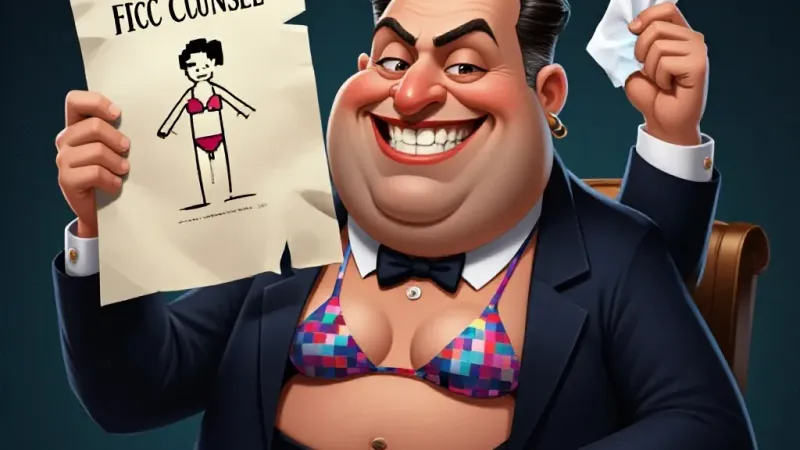
Washington D.C. — In a stunning reinterpretation of American constitutional law, the Federal Communications Commission’s General Counsel, Eric D. Hembree, announced yesterday that he has unlocked the true, hidden meaning of the First Amendment: it grants the government full authority to ban online pornography. Hembree, writing for The Daily Signal, revealed that the framers, in their infinite wisdom, specifically intended for future generations of bureaucrats to determine what content is too 'depraved' for the public to consume.
Hembree's groundbreaking scholarship posits that while the First Amendment ostensibly protects free speech, meticulous analysis of its original parchment reveals an implicit, albeit unwritten, asterisk: '*except for anything Eric D. Hembree finds vaguely distasteful*.' 'The Founders,' Hembree stated in a follow-up interview with Hambry, 'were deeply concerned with the moral fiber of a nascent nation, a concern that clearly extends to the pixelated depravity distributed via fiber optics today. They knew. They just didn't have the words for 'OnlyFans' yet, but the spirit was there, etched into the very soul of the document.' He clarified that this 'original intent' was meticulously discovered after careful review of subtle ink blots and quill-scratch patterns on early drafts, which, when digitally enhanced using proprietary government algorithms, clearly spell out 'no boobies,' 'no butt-stuff,' and 'definitely no feet pics.'
Legal scholars across the nation are scrambling to reconcile Hembree’s findings with two centuries of established jurisprudence, most of whom apparently missed the crucial 'no boobies' subtext. Dr. Penelope Albright, director of the Institute for Aspirational Proximity Studies at the University of Phoenix Online, lauded Hembree's 'courageous excavation of historical justification for whatever modern moral panic you’re currently selling.' She added, 'It takes a special kind of legal genius to make the First Amendment say the exact opposite of what everyone thought it said, just because you personally don't like porn. This is less about constitutional law and more about finding a very old, very dead echo chamber for your current hang-ups.'
Critics fear Hembree’s unique interpretative methodology could open the floodgates for other 'originalist' revelations, potentially uncovering constitutional clauses permitting mandatory church attendance, outlawing rap music, or even requiring all citizens to adopt his personal dietary preferences. Apparently, freedom of speech only applies to the speech that doesn’t offend the sensibilities of whoever happens to be in power, or rather, whoever has a strong enough personal aversion to digital nudity to rewrite history.