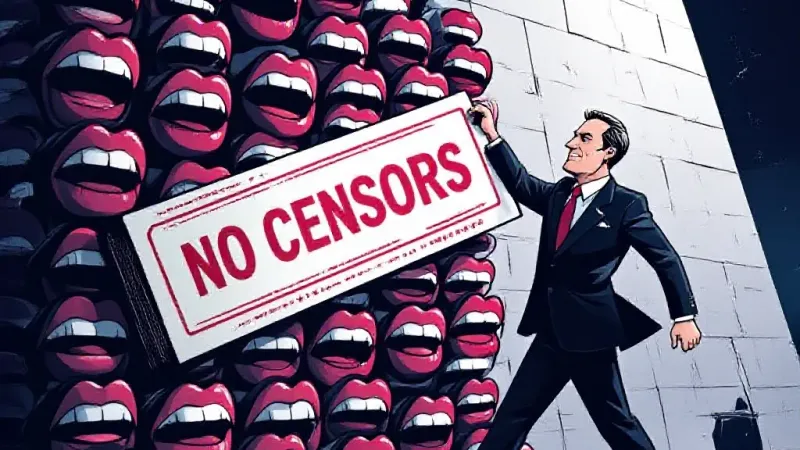
The State Department, under former Secretary of State Mike Pompeo and later championed by Senator Marco Rubio, once sought to protect the nation from "censors" by denying entry to individuals involved in content moderation, disinformation research, or trust and safety roles. In a turn that might generously be described as ironic, a federal court has now informed the U.S. government that its policy constitutes an unconstitutional form of censorship itself, effectively barring the very individuals it claimed to be targeting for a different reason.
Last year, the State Department formalized guidance instructing consular officers to consider denying visas to foreign nationals working in positions related to "misinformation and disinformation research, content moderation, fact-checking, or other compliance and trust & safety roles." The ostensible goal, articulated by some officials, was to combat what they termed a "censorship industrial complex," framing individuals working to mitigate online harms as antagonists to free speech. The practical effect, however, was to potentially bar entry for a wide array of professionals, from academics studying propaganda trends to engineers developing tools to combat child sexual abuse material online for European platforms. The policy conflated the nuanced work of platform governance and information integrity with blanket suppression.
This expansive and ill-defined policy drew swift criticism, not least for its chilling effect on a global workforce critical to digital platforms and academic research. The premise — that those tasked with moderating user-generated content are inherently "censors" whose presence threatens American values — fundamentally misunderstands the complex ecosystem of online information. It also conveniently ignores the often-private, rather than governmental, nature of content moderation, and the distinct difference between a platform's terms of service and state-mandated suppression. The optics alone were challenging: a government agency aiming to curb "censorship" by enacting a policy that effectively functioned as one.
A federal district court in Washington D.C. has now sided with the challengers, ruling that the State Department's policy amounted to an unconstitutional prior restraint on speech. The court found that the policy's vague terms and broad scope directly infringed upon First Amendment protections, stating succinctly that "The government cannot do indirectly what it is prohibited from doing directly." By making visa eligibility contingent on a foreign national's past or present involvement in activities deemed "censorship" by U.S. officials, the State Department effectively created a mechanism to punish certain forms of expression and professional engagement before they could even occur on American soil.
For the media, tech, and journalism industries, this ruling is a critical reminder of the delicate balance between national security concerns and fundamental constitutional rights. It underscores the judiciary's role in checking executive overreach, particularly when policies impact the global flow of information and the professionals who navigate its complexities. The State Department’s attempt to blacklist an entire professional class, under the guise of protecting free speech, was a stark illustration of institutional hypocrisy and a notable misunderstanding of how the internet actually functions. The court’s decision serves as a definitive, if dry, rebuke of an ill-conceived policy.