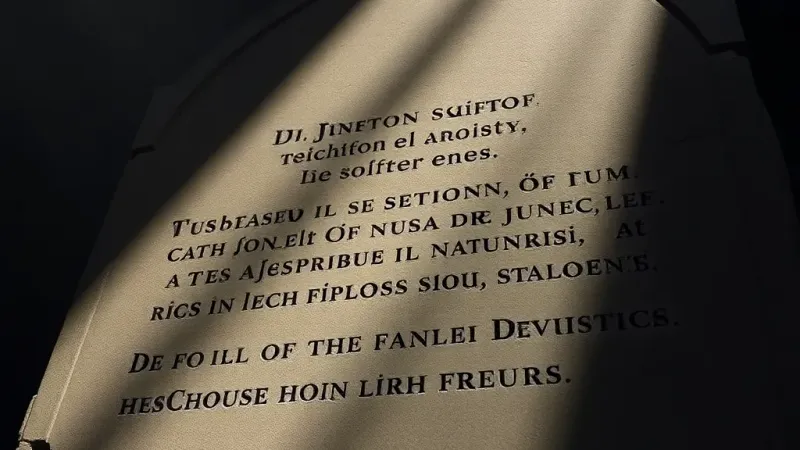
In the solemn grandeur of Dublin's St. Patrick's Cathedral lies the tomb of Jonathan Swift, the legendary Anglo-Irish satirist, essayist, and political pamphleteer. More than 270 years after his death, a single, self-penned inscription etched into his monument continues to captivate and confound scholars: his enigmatic epitaph. Written in Latin, it translates to: 'Here is laid the Body of Jonathan Swift, Doctor of Sacred Theology, Dean of this Cathedral, where fierce Indignation can no longer lacerate his Heart. Go, Traveller, and imitate if you can one who with his utmost strength championed Liberty.' The profound question that has echoed through centuries of literary analysis is whether this declaration of 'fierce Indignation' was a final, grave jest from a master satirist, or a deeply earnest testament to his lifelong disillusionment with humanity.
The starkness of Swift's chosen words offers little immediate clarity. His career was defined by a razor-sharp wit and a profound cynicism regarding human folly, famously displayed in works like *Gulliver's Travels* and *A Modest Proposal*. To some, the epitaph serves as a poignant summation of a life spent observing and critiquing the moral failings of his age, a sincere expression of the weariness that ultimately consumed him. "It paints a picture of a man utterly exhausted by the world's irrationality, finding peace only in death from the constant internal struggle," states Dr. Elara Vance, a historical scholar specializing in 18th-century Irish intellectual history. "This was a figure who truly believed humanity had fallen from grace, and his epitaph reflects that profound, personal despair."
Conversely, many argue that to interpret Swift's final literary act as purely earnest is to misunderstand the very essence of his satirical genius. For a man who cloaked his most searing critiques in layers of irony, the idea of him taking his own epitaph entirely seriously seems almost antithetical to his public persona. Professor Alistair Finch, a renowned expert on satirical literature, suggests an alternative view: "Swift was a master of the double-edged sword. To declare that 'fierce indignation can no longer lacerate his heart' could very well be a final, audacious taunt to a world he found contemptible. It’s the ultimate mic drop, a performative sigh of relief designed to make us wonder if he ever truly cared, or if it was all part of the grand, elaborate performance of his misanthropy."
This debate underscores the enduring power of Swift's legacy. He was not merely a writer; he was a provocateur who challenged societal norms and political corruption with unparalleled intellectual ferocity. His epitaph, located in the very cathedral he served as Dean for over three decades, stands as a testament to his complex character. It embodies the contradictions of a man revered for his intellect yet often reviled for his scathing critiques, a figure whose public declarations often concealed deeper, more intricate meanings. The mystery surrounding its true intent ensures that generations of visitors and scholars will continue to ponder the mind of Jonathan Swift, forever caught between the earnest lament and the final, brilliant joke.