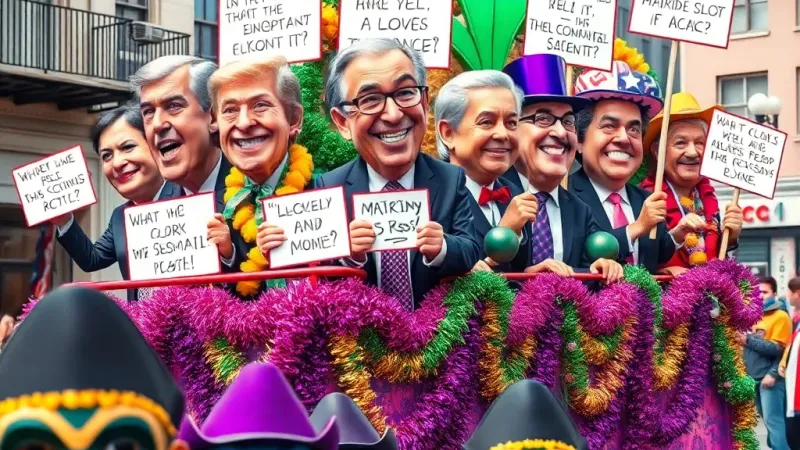
New Orleans, LA – As the vibrant spectacle of Carnival season unfolds, the city's legendary krewes are once again demonstrating their unparalleled prowess in social and political satire. This year, the floats and costumed revelers have zeroed in on two prominent targets: the anticipated departure of Mayor LaToya Cantrell, affectionately known as "Teedy," and the shifting landscape of national politics, marked by a subtle but distinct transition from direct caricature of Donald Trump to the broader, more pervasive concept of "Trumpism." The annual tradition of lampooning power figures and societal trends continues to serve as both a public forum and a cultural catharsis, mirroring the complex sentiments of a city and nation in flux.
Local political commentary has taken a notably prominent position, with numerous krewes bidding a whimsical, yet pointed, "farewell" to Mayor Cantrell. The Krewe of Comus, for instance, unveiled a float themed "Teedy's Terminal," depicting a stylized departure gate complete with oversized suitcases emblazoned with destination tags like "Unknown" and "Next Adventure." A character resembling the mayor was seen waving from a mock airplane window, surrounded by miniature luggage handlers struggling with bags labeled "Infrastructure" and "Public Safety." Eleanor Vance, a lead float designer for the Krewe of Satire, remarked, "It’s less about malice and more about acknowledging a significant shift in city leadership. Carnival has always been about holding a mirror up, and this year, that mirror reflects a collective readiness for transition, wrapped in a healthy dose of New Orleans humor." The intricate details, from the facial expressions of the tiny figures to the satirical destination posters, provided a clear, if humorous, nod to the public discourse surrounding her tenure.
On the national stage, the approach to political satire has evolved from previous years. While direct caricatures of former President Trump were less prevalent, the pervasive influence of "Trumpism" was unmistakably present. Several floats delved into themes of political polarization, misinformation, and the fracturing of public discourse. The Krewe d'Esprit, for example, showcased a striking tableau titled "The Echo Chamber Express," featuring figures trapped in soundproofed compartments, shouting past each other with exaggerated expressions, their words represented by garbled speech bubbles. Another float, "Alternative Realities Arcade," depicted distorted funhouse mirrors reflecting different versions of "truth," underscoring the challenges of discerning fact from fiction in contemporary society. This shift highlights a mature understanding among satirists that the phenomenon extends beyond a single individual, permeating cultural and political fabrics.
This year’s satirical displays serve as a potent reminder of Carnival’s enduring role as a vital outlet for public sentiment in New Orleans. Beyond the dazzling beads and rhythmic brass bands, the parades offer a unique platform where humor is wielded as a sharp instrument of social commentary. It allows citizens to collectively process and articulate grievances, hopes, and observations in a culturally sanctioned, celebratory manner. Marcus Dubois, a long-time parade-goer from the Marigny, shared his perspective: "In New Orleans, we deal with everything – joy, sorrow, politics – through celebration. If you can't laugh at it, you can't get through it. These floats, they tell our story, the good and the complicated." This communal act of comedic critique reinforces the city's democratic spirit, ensuring that even during its grandest festival, critical engagement remains central.