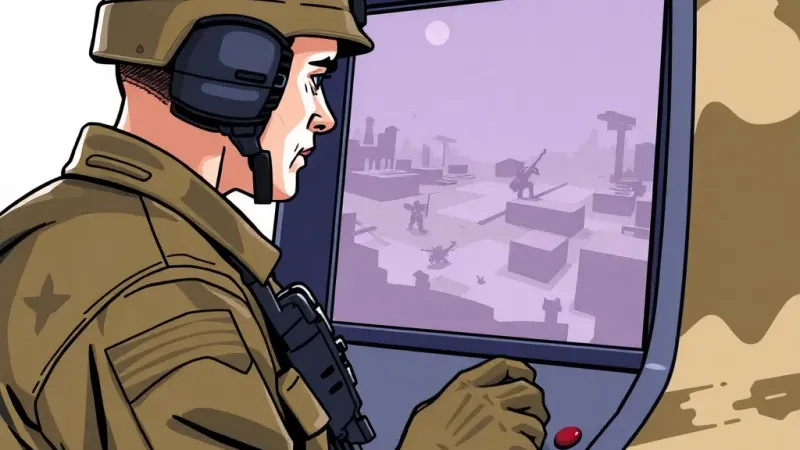
A video circulating widely online has ignited a fervent discussion regarding the conduct and morale of National Guardsmen currently deployed in Washington D.C., depicting several service members appearing to play a satirical arcade game centered on a fictional war with Iran. The footage, first shared across social media platforms over the weekend, captures individuals in military attire engrossed in "Iranian Dawn," a known indie title designed to critique military-industrial complexes and jingoistic foreign policy. This unexpected scene unfolds against the backdrop of an unprecedented military presence in the nation's capital following the January 6th Capitol breach, prompting questions about professionalism and public perception.
"Iranian Dawn" is not a typical war simulator; it's a deliberately over-the-top, retro-styled arcade experience that lampoons the concept of perpetual conflict. Its developers intended it as a biting commentary, using exaggerated graphics and sound effects to highlight the absurdity of aggressive foreign policy. The game reportedly features cartoonish explosions and overtly simplistic objectives, a far cry from realistic combat simulations. The deployment in D.C. has seen thousands of Guard members stationed across various points, often in public view, leading to heightened scrutiny of their activities.
The emergence of the video has drawn mixed reactions. Critics argue that playing such a game, particularly one depicting a conflict with a real-world adversary like Iran, demonstrates poor judgment and could be perceived as insensitive or even mocking, especially given the seriousness of their mission. "It's deeply concerning to see our protectors seemingly trivializing potential real-world conflicts, especially while serving in such a visible and critical capacity," stated Eleanor Vance, a local resident and community organizer, reflecting a sentiment shared by many online commentators. "It casts a shadow over the immense sacrifices these men and women are making."
Conversely, proponents suggest the incident is being overblown and misconstrued. Some argue that the Guardsmen, enduring prolonged deployments and stressful conditions, were likely seeking a moment of respite and distraction, unaware of or indifferent to the game's deeper satirical nuances. "Our service members are under immense pressure, and they're human," commented retired Major General Arthur Jenkins, a military analyst. "A moment of recreation, even with an arcade game, should not be misconstrued as a reflection of their commitment or respect for their duties. The game's intent as satire is often lost on a casual observer, and these individuals are likely just trying to unwind."
The incident underscores the unique challenges of maintaining a military presence in a civilian environment, particularly when the lines between official duty and personal downtime become blurred in public spaces. As the National Guard continues its mission in Washington D.C., often housed in temporary facilities or public buildings, questions persist about appropriate conduct, the provision of adequate recreational outlets, and the nuanced interpretation of actions in the ever-present glare of social media. The episode serves as a stark reminder of the constant vigilance required not just in security operations, but also in managing public perception in an age where every action can be instantly broadcast and dissected globally.