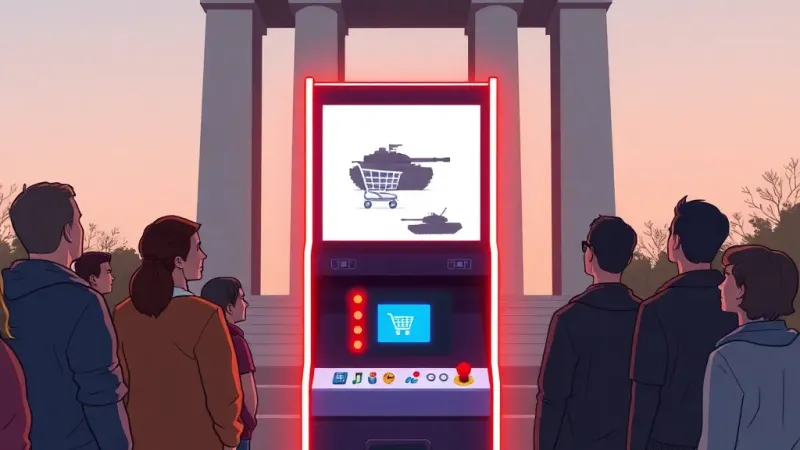
A retro arcade cabinet, starkly out of place amidst the solemnity of the DC War Memorial, became an unexpected focal point this week, confronting visitors with a peculiar, unsettling digital choice: "Order a Diet Coke, or Bomb Iran?" The interactive installation, dubbed "Diet or Bomb," immediately drew curiosity and consternation, serving as a potent piece of public satire regarding the perceived casualness of grave geopolitical decisions.
The game, housed within a nondescript, beige-toned arcade console with a classic CRT monitor, presented players with a simple, two-button interface. One button was labeled "Diet Coke," the other "Bomb Iran." Pressing either button resulted in a brief, pixelated animation confirming the selection, followed by a return to the initial choice screen. The creators of the enigmatic game remain anonymous, leaving the provocative commentary to speak for itself through its stark simplicity and the gravity of its implied critique.
Its strategic placement at the National Mall, a site steeped in American history and sacrifice, amplified its message. The DC War Memorial, dedicated to the men and women from the District of Columbia who served in World War I, stands as a testament to the profound costs of conflict. Introducing a game that trivializes such decisions in this sacred space has sparked varied reactions among the public. "It’s jarring, isn’t it?" observed Eleanor Vance, a retired history teacher visiting from Ohio. "To see something so flippant about war, right here where we remember those who paid the ultimate price. But perhaps that's the point – to make us feel uncomfortable, to truly consider the weight of these choices."
The "Diet or Bomb" game taps into a rich tradition of political satire, using humor and absurdity to highlight serious societal issues. Its immediate impact lies in its ability to condense complex foreign policy dilemmas into a binary, consumer-like choice, implicitly criticizing the rhetoric that often reduces intricate global dynamics to simplistic propositions. This form of digital street art forces an immediate, visceral reaction, bypassing traditional media filters and delivering its message directly to an unwitting audience.
Public art curator, Dr. Marcus Thorne, commented on the installation's effectiveness. "This piece leverages the unexpected to disrupt complacency," he stated during an interview. "By juxtaposing a trivial consumer choice with an act of war, the artist compels us to reflect on the gravity of political rhetoric and the processes by which such monumental decisions are made. It's a stark reminder that policy is not a game, despite how it might sometimes be presented." The game has since been removed, but its brief presence has ignited conversations about the role of satire in public discourse and the often-unseen consequences of abstract geopolitical strategies.