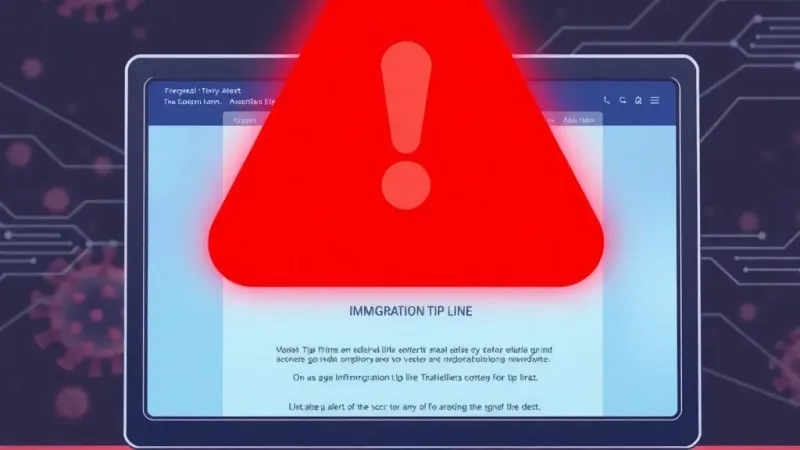
Washington D.C. – The Department of Homeland Security (DHS) has issued an internal alert concerning a satirical website created by comedian Leo Maxwell, which meticulously parodies the official U.S. Immigration and Customs Enforcement (ICE) tip line. The website, aptly named "ICE-Tips.us," closely mirrored the visual design and navigational elements of legitimate government portals, prompting federal officials to flag it as a potential source of public confusion and misdirection.
Maxwell, known for his politically charged humor, launched the site last month, replacing the serious prompts for immigration violations with absurd, fictional scenarios. Visitors were encouraged to report neighbors for 'suspiciously perfect lawn care,' 'unusual nocturnal humming,' or 'failure to adequately appreciate local wildlife.' Despite clear disclaimers often hidden in the footer or only visible after clicking specific links, the uncanny resemblance to a bona fide government service raised red flags within federal agencies.
Deputy Director Eleanor Vance, a spokesperson for the DHS Cybersecurity and Infrastructure Security Agency (CISA), articulated the department’s concerns in a statement to this news organization. “While we respect freedom of expression, the proliferation of websites that closely mimic critical government services, even for satirical purposes, poses a tangible risk,” Vance stated. “Such sites can inadvertently siphon off legitimate public inquiries, drain valuable resources, and sow distrust in authentic government communication channels. Our alert is a precautionary measure to ensure our personnel are aware and vigilant.” Vance emphasized the department's mandate to protect the integrity of official communications, regardless of intent.
However, free speech advocates and legal experts have swiftly weighed in, questioning the proportionality of a federal security alert directed at a comedian. Dr. Ben Carter, Professor of Media Studies at Harrington University, described the DHS response as an overreach. “Satire has a long and vital history as a tool for social commentary and critique,” Dr. Carter explained. “To issue a security alert over what is clearly, to any reasonably discerning individual, a comedic endeavor, suggests an alarming lack of understanding of modern digital literacy and, more concerningly, a potential chilling effect on artistic expression.” He argued that the government's energy might be better spent on combating truly malicious misinformation.
The incident underscores the escalating tension between online parody and perceived governmental threats in the digital age. As the lines between entertainment and official communication blur, federal agencies face the complex challenge of distinguishing genuine security risks from clever, albeit provocative, artistic statements. The ongoing debate highlights the crucial need for clear digital literacy among the public and a nuanced approach from authorities when confronting online content that, while unconventional, serves as a form of social critique.