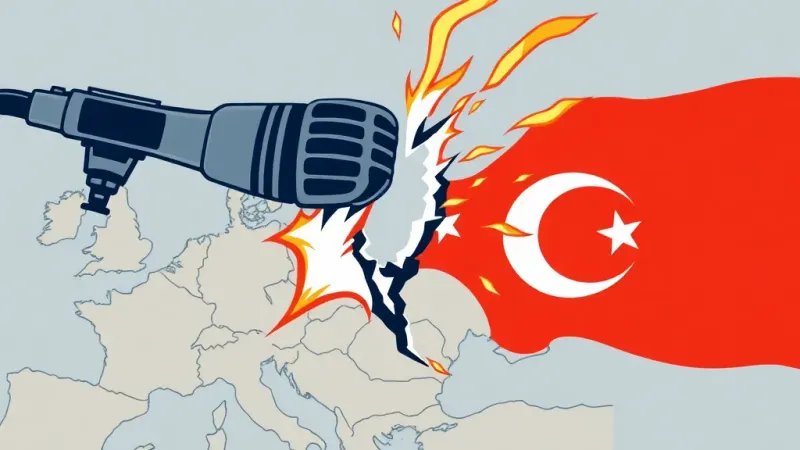
BERLIN – A politically charged poem broadcast by German comedian Jan Böhmermann in March 2016 unleashed a significant diplomatic and legal dispute, testing the boundaries of satire and free expression within international relations. The incident, centered on a deliberately offensive piece about Turkish President Recep Tayyip Erdoğan on Böhmermann's ZDF program, “Neo Magazin Royale,” quickly escalated from a television segment into a contentious international affair, forcing Germany to confront difficult questions about its commitment to artistic liberty.
The segment, labeled by Böhmermann as “Schmähkritik” (abusive criticism), was explicitly designed to demonstrate the legal difference between permissible satire and illegal defamation under German law. It followed an earlier incident where Erdoğan had protested against a satirical song broadcast by NDR. Böhmermann's poem crossed conventional lines, containing explicit language and highly personal insults, which he prefaced by explaining his intent was to illustrate what would constitute a legally actionable offense, thereby highlighting the protected nature of legitimate satire. This clear provocation, however, quickly spiraled beyond its intended academic exercise.
The immediate fallout was severe. Turkey formally requested Germany to initiate criminal proceedings against Böhmermann under Section 103 of the German Criminal Code, a rarely used provision outlawing the insult of foreign heads of state, often referred to as “Lèse-majesté.” This unprecedented demand placed considerable pressure on the German government, sparking a fervent public and political debate about freedom of the press and the role of satire in a democratic society. Thousands took to social media, rallying behind Böhmermann with the hashtag #jesuisböhmi, echoing sentiments of solidarity with free expression.
Chancellor Angela Merkel’s government ultimately acceded to Turkey’s request, permitting prosecutors to pursue the case. This decision, though legally permissible, drew widespread condemnation from human rights organizations and free speech advocates across Germany and beyond. "To allow a foreign leader's complaint to dictate the parameters of domestic free speech sets a dangerous precedent," remarked Professor Anya Schmidt, a constitutional law expert at the University of Berlin. "It risks chilling legitimate criticism and undermines the very principles our democracy stands upon."
While a regional court later issued a preliminary injunction banning large parts of the poem, the broader political consequence was profound. The controversy ultimately led to the German Bundestag's decision to repeal Section 103 of the Criminal Code, effective January 2018, underscoring the incident's lasting impact on German jurisprudence. The Böhmermann affair not only strained German-Turkish relations but also catalyzed a vital national conversation on the limits of artistic freedom in an increasingly interconnected and sensitive global landscape.